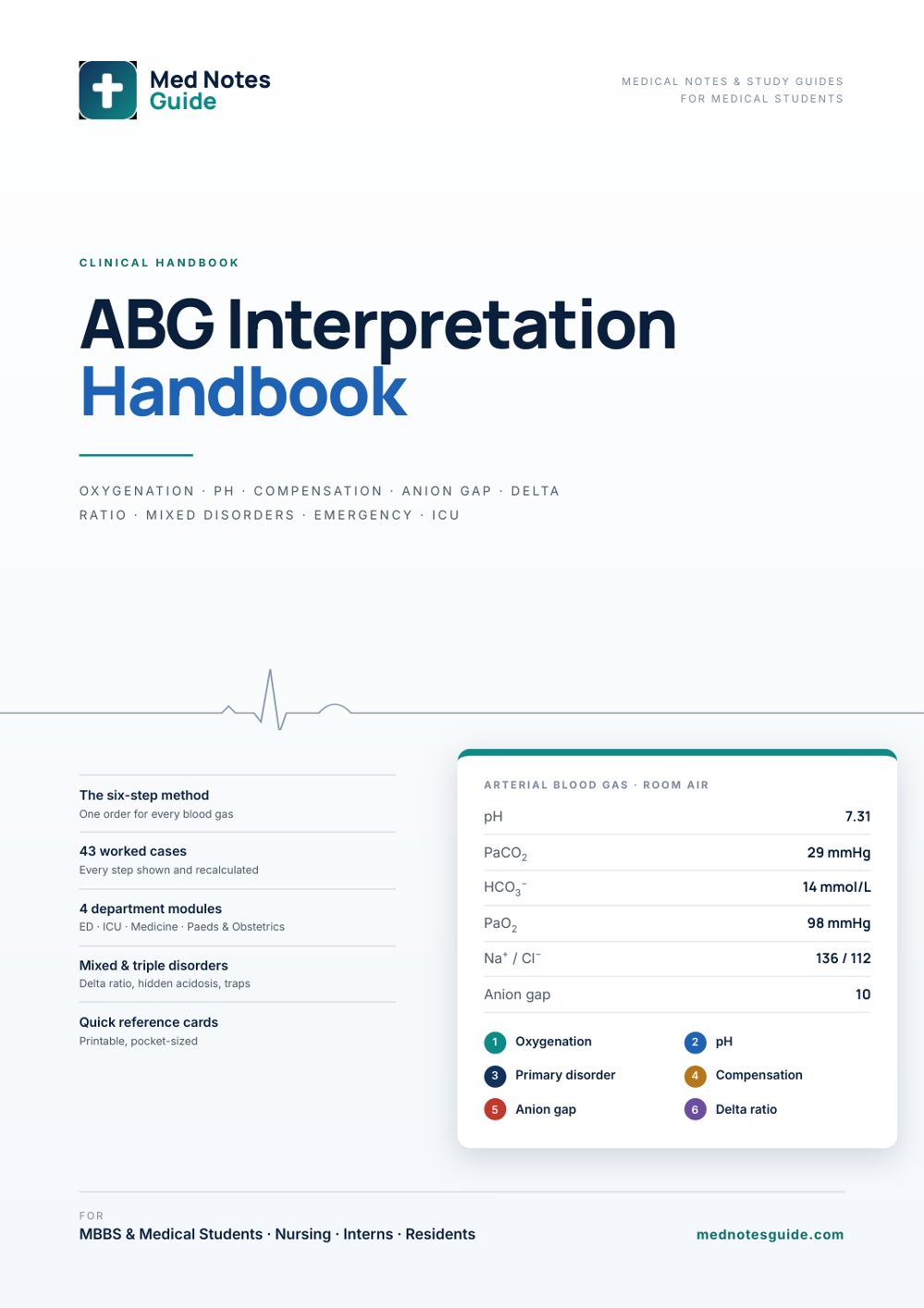
ABG INTERPRETATION HANDBOOK
For medical & nursing students, interns and residents

Read any blood gas in six steps. Stop guessing on the ward.

A 90-page illustrated handbook that gives you one method for every ABG: oxygenation, pH, primary disorder, compensation, anion gap and delta ratio. Then 43 worked cases to make it automatic.

  • 6-step method
  • 43 worked cases
  • 10-gas self-test
  • 4 department modules
  • Quick reference cards
$19Launch price · one-time
Get the ABG Handbook · $19

90-page PDF · delivered to your email in minutes · one-time payment · Cards, Apple Pay & Google Pay via Stripe
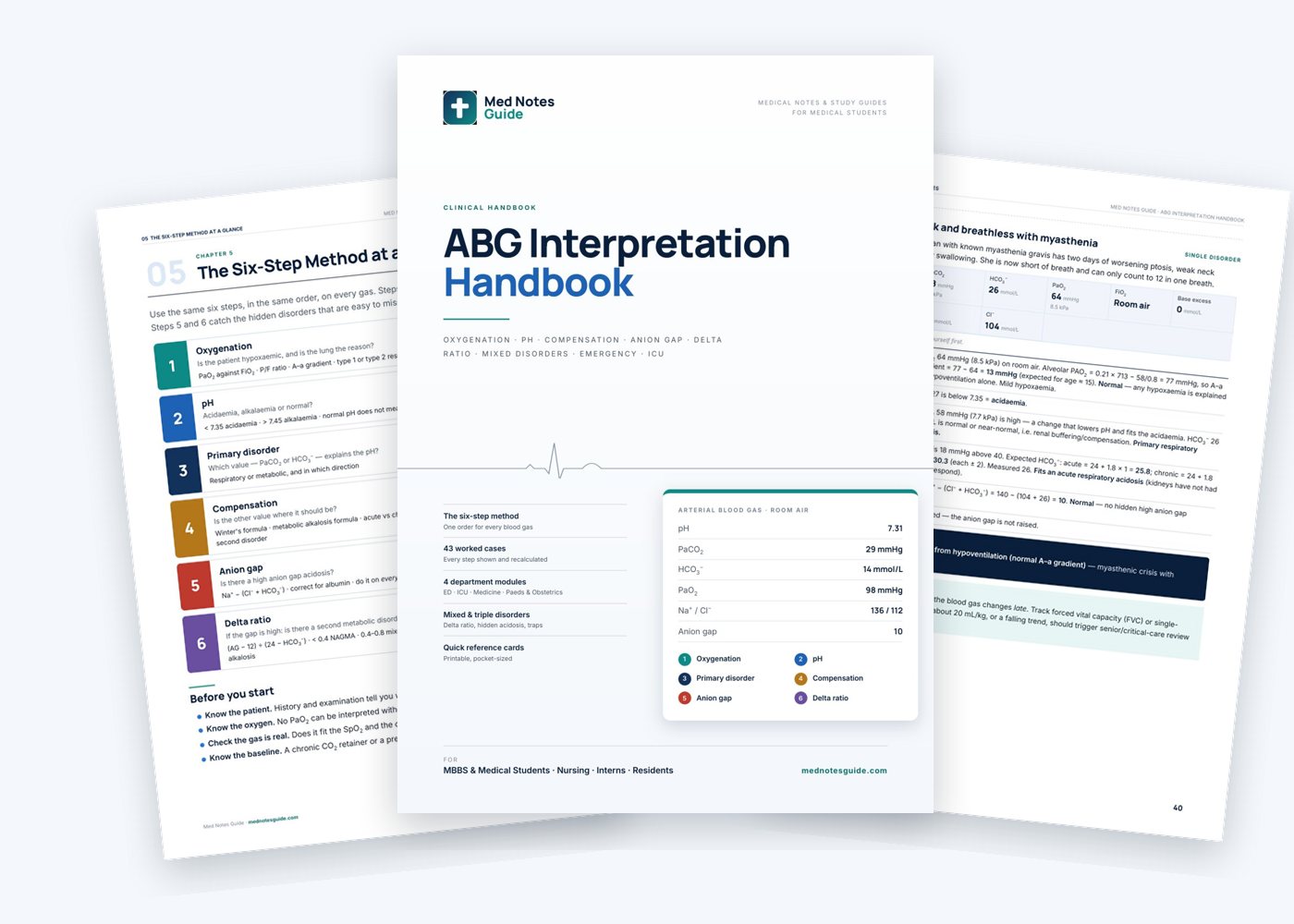
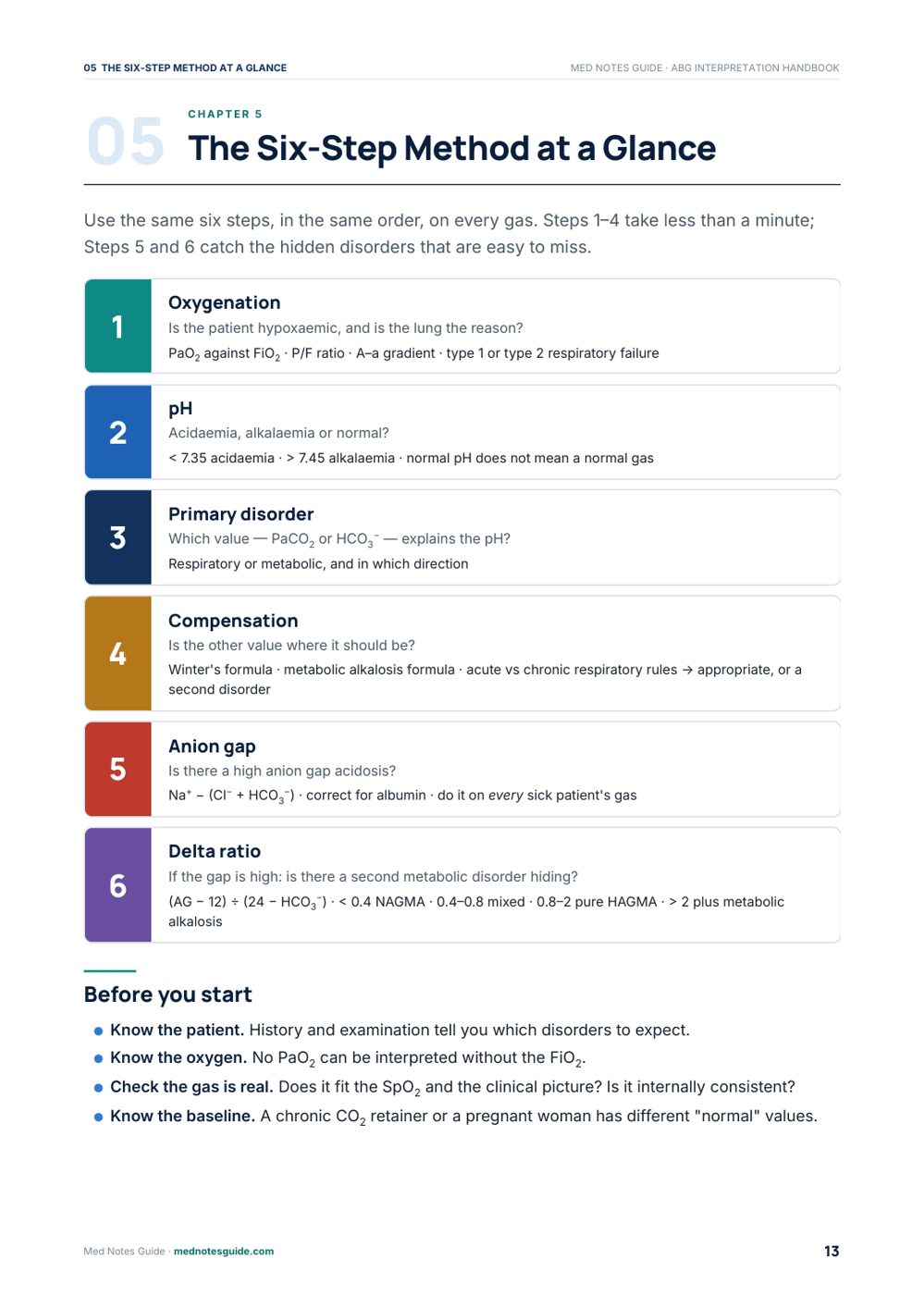
ABG Interpretation Handbook cover with pages from the six-step method and a worked case
Sound familiar?

Someone hands you a blood gas. Now what?

Arterial blood gas · room air
pH7.31
PaCO₂29 mmHg
HCO₃⁻14 mmol/L
Na⁺ / Cl⁻136 / 112
Is the patient compensating? Is there a second disorder hiding?

You know the normal ranges. You have seen "ROME" on a slide. But with a real result in front of you, on a ward round or in a viva, the steps blur together:

The problem isn't that ABGs are hard. You were never given one order to follow, every time, and enough cases to practise it.

The method

Six questions, in the same order, on every gas.

Each step has its own colour throughout the book, so you always know where you are. Steps 1–4 take under a minute. Steps 5 and 6 find the disorders most students miss.

1
OxygenationPaO₂ against FiO₂, P/F ratio, A–a gradient, type 1 vs type 2 failure
2
pHAcidaemia, alkalaemia, or a "normal" pH that hides two disorders
3
Primary disorderWhich value explains the pH: CO₂ or bicarbonate?
4
CompensationWinter's formula and the acute vs chronic rules, with worked numbers
5
Anion gapCorrected for albumin, with GOLD MARK and HARDUPS for the causes
6
Delta ratioFinds the second metabolic disorder hiding behind the first
Try it on the gas above
pH7.31
PaCO₂29
HCO₃⁻14
  1. pH 7.31: acidaemia.
  2. HCO₃⁻ 14 is low and explains it: primary metabolic acidosis.
  3. Winter's: 1.5 × 14 + 8 = 29 ± 2. Measured 29, so compensation is appropriate.
  4. Anion gap: 136 − (112 + 14) = 10, normal.
Normal anion gap metabolic acidosis, appropriately compensated. Think diarrhoea, renal tubular acidosis or saline, and the handbook shows you how to tell them apart.
Look inside

Real pages from the handbook

Clean A4 pages, colour-coded steps and every calculation written out. Every gas tension is shown in mmHg and kPa, so it works whether your hospital reports one or the other.

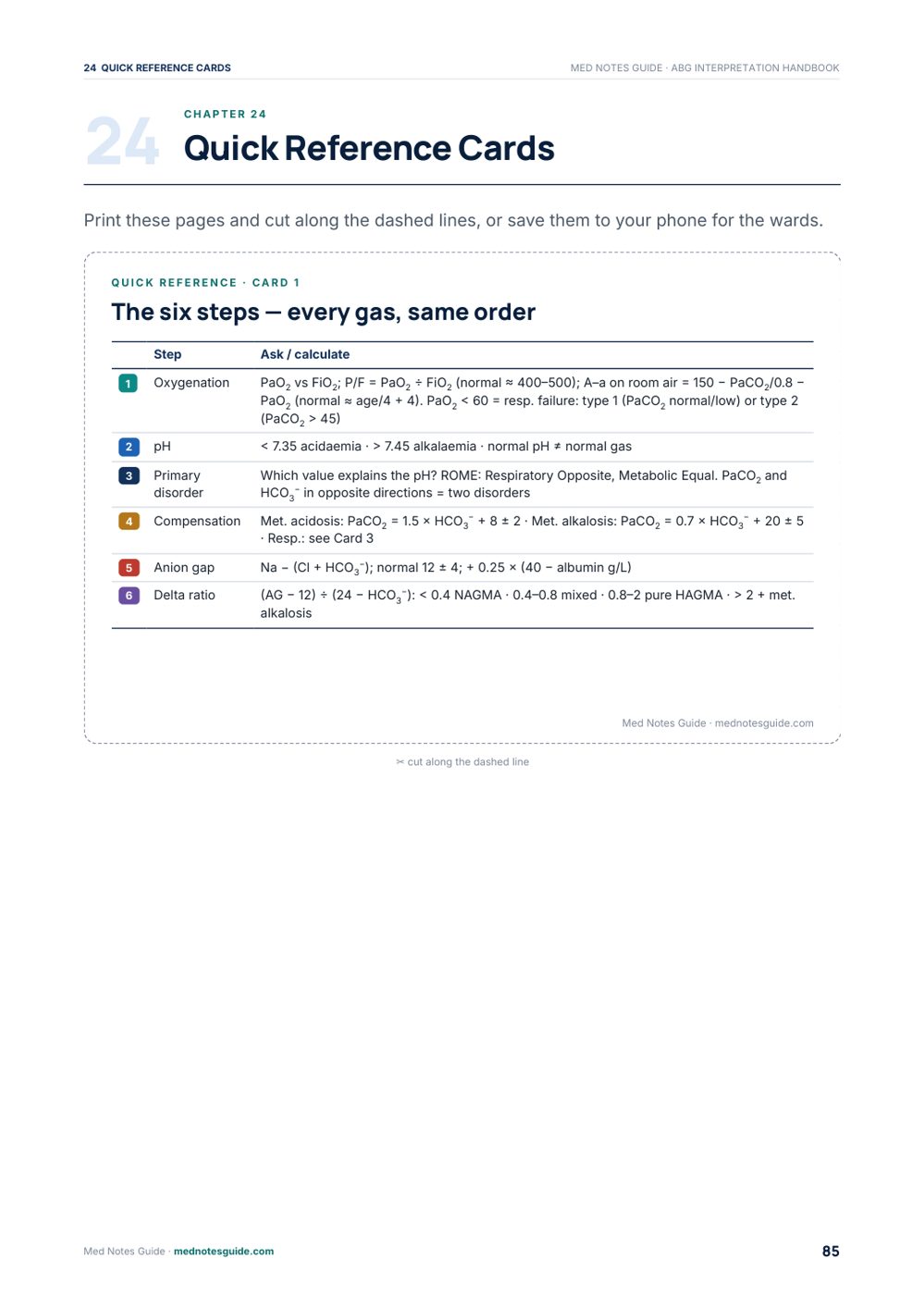
The six-step method at a glance
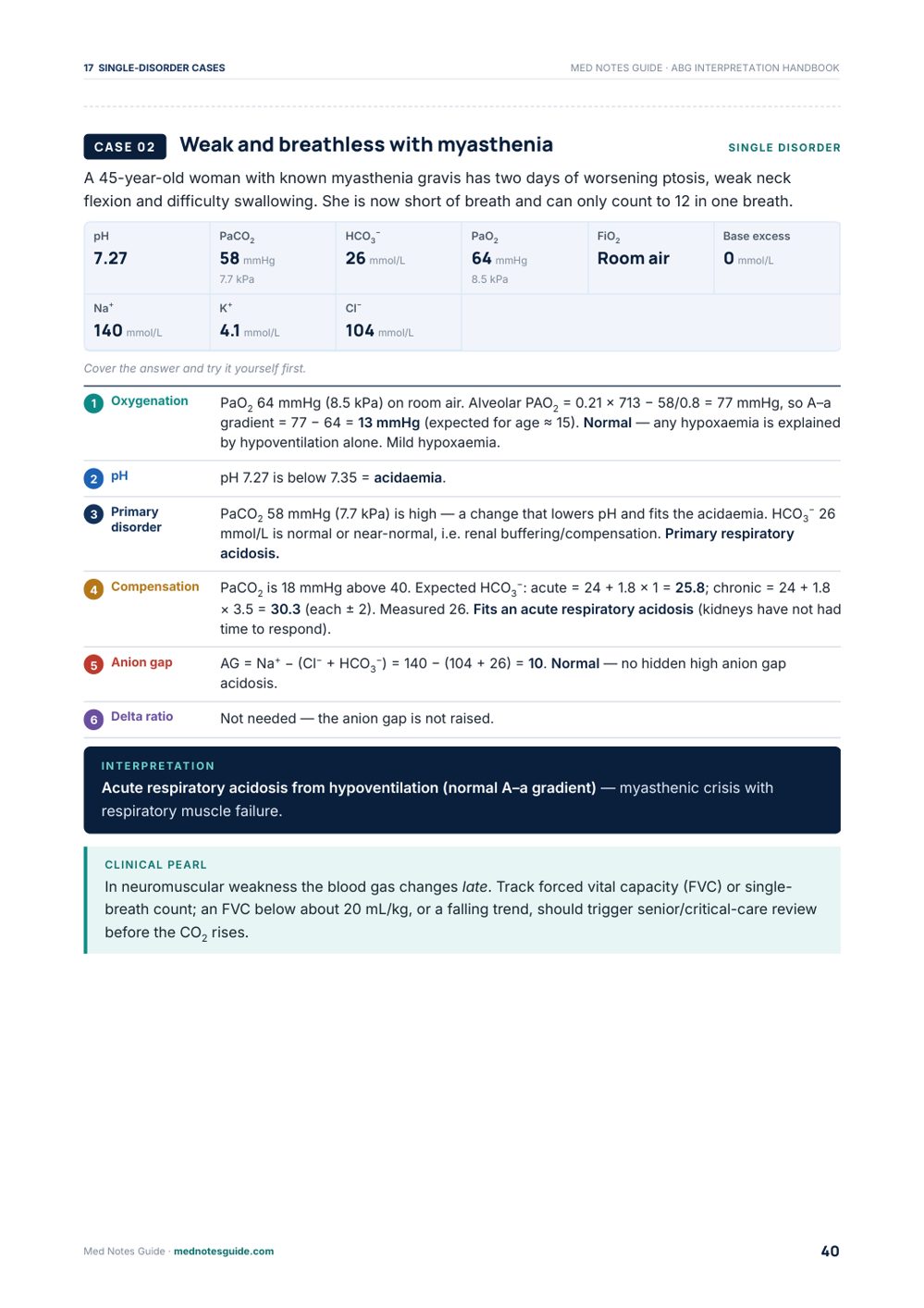
A fully worked case
Every case worked through all six steps
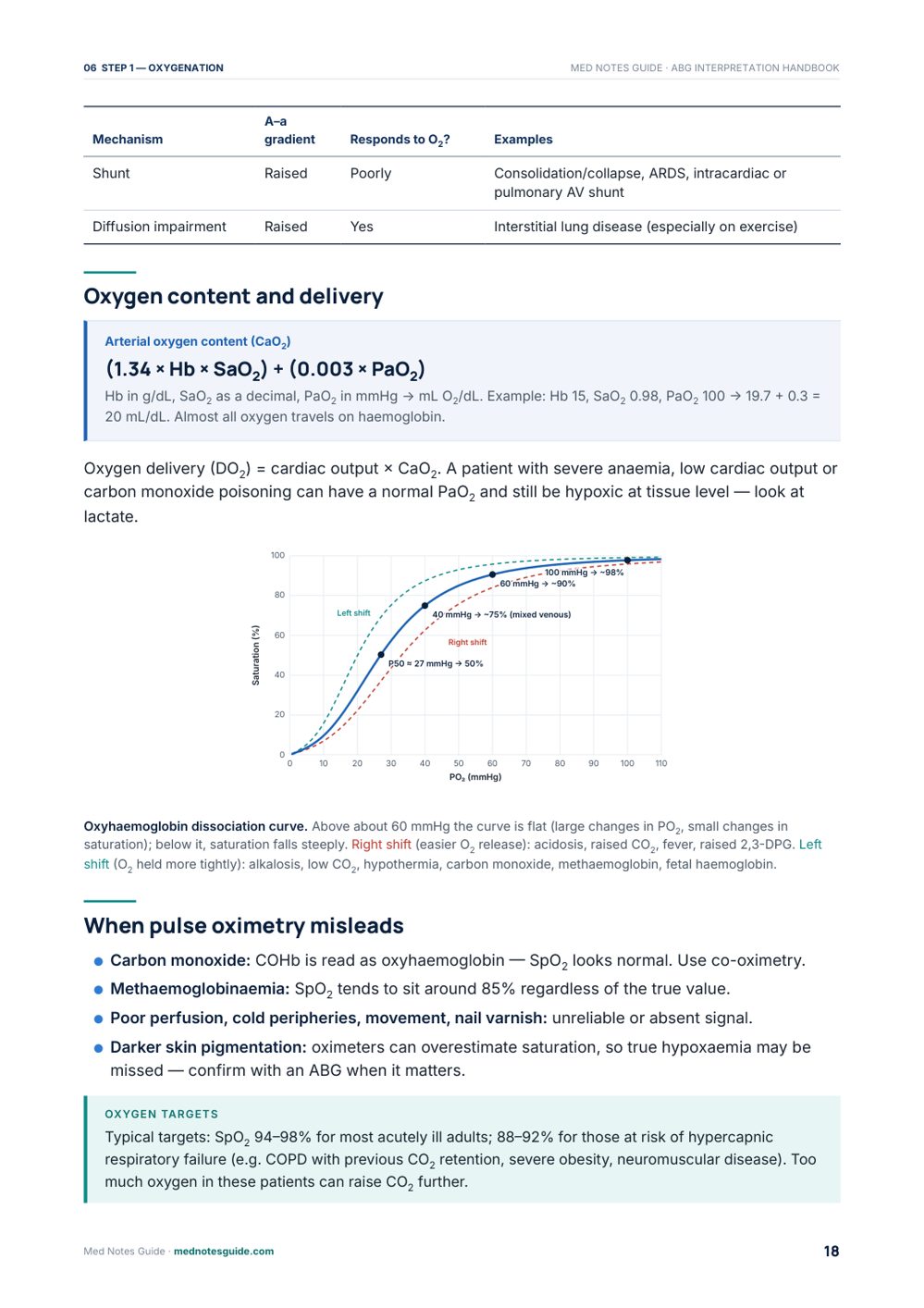
Oxygenation chapter page with dissociation curve
Oxygenation: P/F, A–a gradient, the O₂ curve
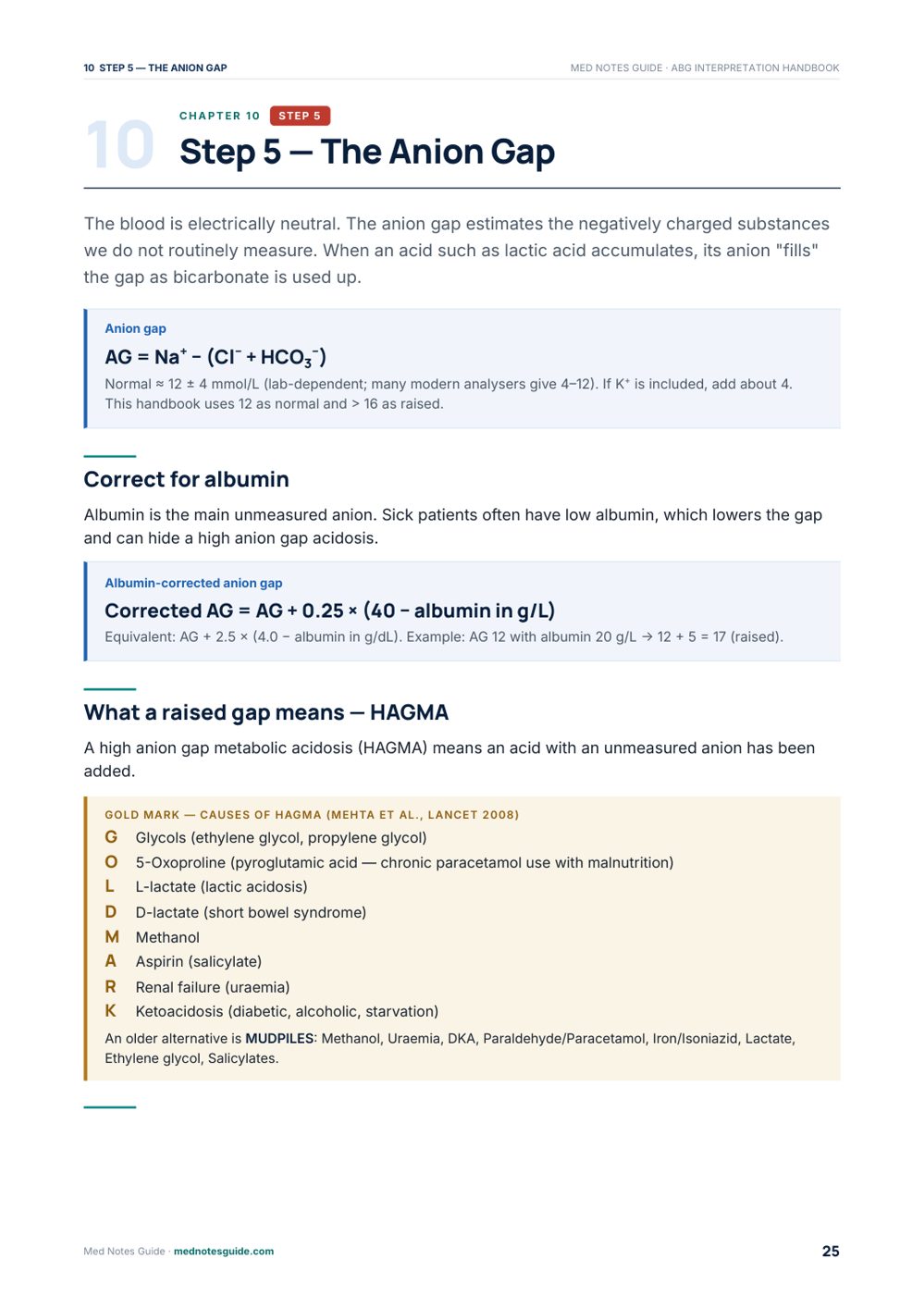
Anion gap chapter page
Anion gap, albumin correction, GOLD MARK
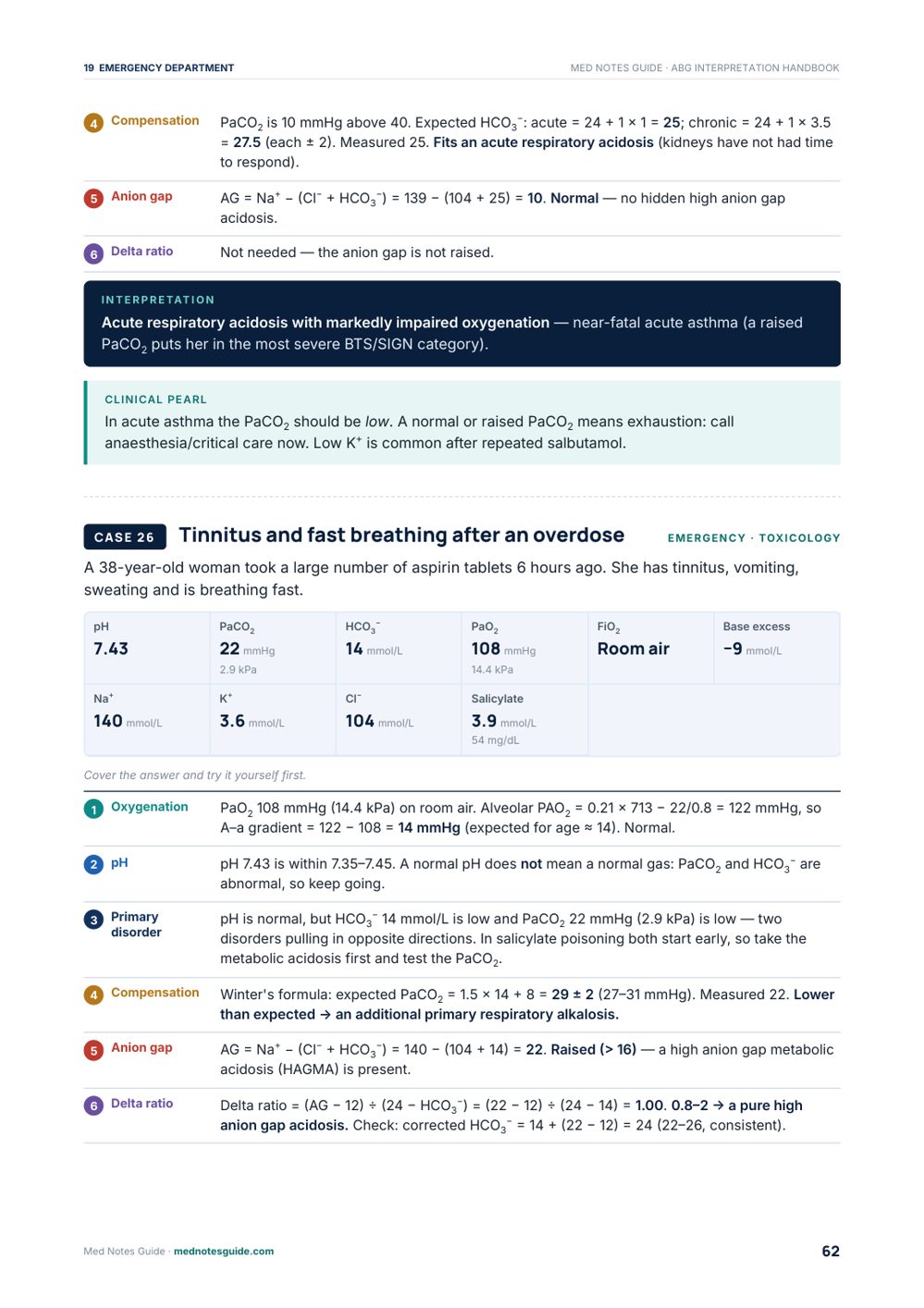
Emergency department module cases
Emergency module: toxicology cases
Printable quick reference cards
What you get

Everything you need to read gases with confidence

1
The six-step method, explained properlyOne chapter per step: the formula, the logic behind it and the common traps. Normal values in mmHg and kPa.
43
43 fully worked casesFrom single disorders to triple disorders, the albumin trap, the "normal" gas and the venous sample. Every number recalculated.
4
4 department modulesEmergency, ICU (with ventilator adjustments), Medicine & Nephrology, and Paediatrics & Obstetrics, including cord gases.
10
10-gas self-test with answer keyNo worked steps, just like the exam or the ward. Check yourself against the key.
6
6 printable quick reference cardsSteps, normal values, compensation formulas, anion gap causes, delta ratio and oxygenation, for your pocket or phone.
✓
The four disorders, in depthCauses, clinical features and management principles for each, plus a full chapter on mixed and triple disorders.
Before and after

What changes when you have one method

Without a method

  • You stop after naming one disorder
  • Compensation is a guess
  • The anion gap only gets checked when someone reminds you
  • A normal pH convinces you the gas is normal
  • Different formula from every source

With the six steps

  • Same six questions, same order, every time
  • Expected compensation calculated, not guessed
  • Anion gap and delta ratio done on every sick patient
  • Mixed and triple disorders spotted from the numbers
  • One consistent set of formulas, printed on a card
Is it for you?

Who this handbook is for

Made for you if you are…

  • A medical student preparing for USMLE Step 1 & Step 2 CK, COMLEX, med school and nursing school exams, and ward rounds
  • A nursing student or nurse working in ED, ICU or wards
  • An intern or resident who wants a reliable routine for night shifts
  • Anyone who "sort of" understands ABGs but freezes on mixed disorders

Not for you if…

  • You want a full respiratory physiology textbook
  • You are looking for a quick list of normal values only
  • You want a clinical protocol to replace your hospital's guidelines
Get it today

The ABG Interpretation Handbook

ABG Interpretation Handbook cover

90-page illustrated PDF

Instant email delivery · read on phone, tablet or laptop · printable

  • Six-step method with every formula
  • 43 worked cases + 10-gas self-test
  • ED, ICU, Medicine & Nephrology, Paeds & Obstetrics modules
  • 6 printable quick reference cards
  • mmHg and kPa throughout
$19Launch price · one-time
Get Instant Access · $19

One-time payment · no subscription · Cards, Apple Pay & Google Pay via Stripe
Questions

Frequently asked questions

How do I receive the handbook?

Right after payment you are emailed the PDF. Use an email address you check, and look in spam or promotions if it hasn't arrived within a few minutes.

What's inside, exactly?

90 A4 pages in 10 parts: foundations and normal values, the six-step method (one chapter per step), the four disorders in depth, mixed and triple disorders, a 23-case core bank, 4 department modules with 20 more cases, a 10-gas self-test with answers, 6 quick reference cards and abbreviations.

Is it right for my level?

It starts from the basics and builds to mixed and triple disorders, so it suits medical and nursing students, interns and residents. Use it alongside your lectures and textbooks.

Does it use mmHg or kPa?

Both. Gas tensions are shown in mmHg with kPa beside them, and the key formulas are given in both units.

Can I print it or read it on my phone?

Yes. It's a standard PDF with bookmarks and clickable contents. The quick reference cards are designed to print and cut out.

Is it a subscription?

No. One payment and the PDF is yours.

What's the refund policy?

The handbook is delivered instantly, so all sales are final. If you have any trouble downloading it, email support@mednotesguide.com and we'll help.

The next blood gas you see, read it in six steps.

One method, 43 worked cases and a pocket card, for less than a textbook chapter.

$19
Get the ABG Handbook · $19

90-page PDF · instant email delivery · one-time payment

$1990-page PDF
Get the Handbook →