Why MBBS students re-learn the same topics before every prof exam (and the 4-step fix)
The problem usually isn't how much you study. It's how you revise. Here's an evidence-based method you can start this week, with a printable timetable and a quick checklist.
You read the nephron in first year. You understood it. Then you met it again in pathology, then again in pharmacology, and each time it felt like meeting a stranger.
So before every internal, every prof, you do the same thing: pull out the big textbook, the lecture PPTs, a senior's handwritten notes, two YouTube channels and a PDF someone forwarded at midnight. Three hours later you've rebuilt one topic. There are a few hundred more.
Most MBBS students don't forget because they didn't study. They forget because they studied the same thing in five places and never practised pulling it back out of memory.
Why this keeps happening
MBBS is a volume problem. Anatomy, physiology and biochemistry in first year; pathology, pharmacology, microbiology and forensic medicine in second; then community medicine, ENT, ophthalmology, and finally medicine, surgery, OBG and paediatrics. The same organ comes back again and again, from a different angle each time.
Three habits make that volume much harder than it needs to be:
- Too many sources. Every revision starts with searching and reconciling, not remembering.
- Re-reading instead of recalling. Re-reading feels productive because the text looks familiar. Familiar isn't the same as retrievable in an exam hall.
- Subjects in silos. Renal physiology, renal pathology and diuretics get learnt months apart, so nothing links up and each one decays on its own.
The good news: learning research has studied exactly these habits, and the fixes are simple. A widely cited review of ten common study techniques (Dunlosky et al., 2013) rated practice testing and spaced (distributed) practice as the two most useful, and rated re-reading and highlighting as low utility.1
Step 1Pick one primary source per subject
Choose a single, organised set of notes for each subject and make it home base. Textbooks, lectures and videos still matter, but anything new you learn gets added to that one source (a margin note, a sticky tab, an extra line in a table). Revision always starts in the same place.
Your primary source should be:
- Organised by system or chapter, with a contents page you can jump around in
- Heavy on tables, flowcharts and labelled diagrams, not paragraphs
- Short enough to revise from in the final weeks (your standard textbook stays your reference)
Building this yourself works, but across 19 subjects it can take years. This is the gap our guides are designed to fill (more on that below).
Step 2Test yourself instead of re-reading
In a classic experiment, students who read a passage once and then took recall tests remembered more a week later than students who spent the same time re-reading it, even though the re-readers felt more confident (Roediger & Karpicke, 2006).2 Medical-education researchers have argued for using this same "testing effect" in medical training (Larsen et al., 2008).3
What that looks like on an ordinary MBBS evening:
Close the notes. Write the classification of anti-hypertensives, or draw the brachial plexus, from memory. Then open the notes and correct in a different colour. The corrections are what you revise next time.
Hide one column of a table (causes, drug of choice, side effects) and say it out loud before you uncover it.
Attempt MCQs and a short-answer question on a topic before revising it. Your wrong answers show you exactly where to spend the time.
Practise answering "a 45-year-old man presents with…" out loud. For OSCEs, rehearse the same examination routine (introduce, consent, inspect, palpate, percuss, auscultate, summarise) until it runs on autopilot.
Need questions to test yourself with? Our Practice Exams are 15 subject booklets of MCQs, short-answer questions and clinical cases, with an answer key after every quiz so you can check yourself straight away. ₹699 for the set.
See the Practice Exams →Space your reviews (and put them in a calendar)
A large review of distributed-practice studies found that spreading reviews out produces better long-term retention than massing the same total time into one session (Cepeda et al., 2006).4 There's no single perfect interval, but a simple, widely used pattern is: learn it, then review on day 1, day 3, day 7 and day 21, then once more in the final month.
Each review should be short and active: 10 to 20 minutes of recall from your one source, not a re-read.
Here's how that maps onto a typical week. Print it or screenshot it:
| Day | New topic (60–90 min) | Spaced reviews (15 min each) | Self-test |
|---|---|---|---|
| Mon | Topic A | Last week's topics due today | 10 MCQs on A |
| Tue | Topic B | A (day 1) | Blank-page recall: A |
| Wed | Topic C | B (day 1) | 1 SAQ on B |
| Thu | Topic D | A (day 3) · C (day 1) | Cover-the-table: C |
| Fri | Topic E | B (day 3) · D (day 1) | 1 clinical case |
| Sat | Catch-up / weak spots | C (day 3) · E (day 1) | Mixed MCQs, A–E |
| Sun | Rest or light reading | D (day 3) | Note down anything you missed |
Day-7 reviews land on next week's same day; day-21 reviews three weeks on. A simple paper or phone calendar is enough to track them.
Mapping it to your prof calendar: count back from the exam date. Everything you learn in the term should get its day-1/3/7/21 reviews during term; the last 30 days are then for a final pass and heavy self-testing, not first-time learning.
Step 4Revise system-wise, not subject-wise
Instead of revising "all of pathology" and later "all of pharmacology", take one organ system at a time and run it straight through:
Each layer explains the next, so you remember them together. It also matches how integrated and clinical questions are asked.
One evening on the renal system
- Physiology: draw the nephron from memory and label where sodium is reabsorbed: proximal tubule, thick ascending limb (Na-K-2Cl co-transporter), distal tubule (Na-Cl co-transporter), collecting duct (aldosterone-sensitive channels).
- Pathology: now the glomerulus is damaged. Compare the two big patterns in a table:
Nephrotic: heavy proteinuria (>3.5 g/day), low albumin, oedema, hyperlipidaemia.
Nephritic: haematuria with RBC casts, hypertension, reduced urine output, milder proteinuria. - Pharmacology: go back to the nephron you drew. Loop diuretics (furosemide) block the Na-K-2Cl transporter in the thick ascending limb; thiazides block Na-Cl in the distal tubule; spironolactone antagonises aldosterone in the collecting duct. Now you know why loop diuretics are used for oedema, and why hypokalaemia is a side effect of both loops and thiazides.
- Self-test: close everything and answer: "A child has periorbital puffiness and frothy urine. Nephrotic or nephritic? Which investigation first? Which diuretic, and what would you monitor?"
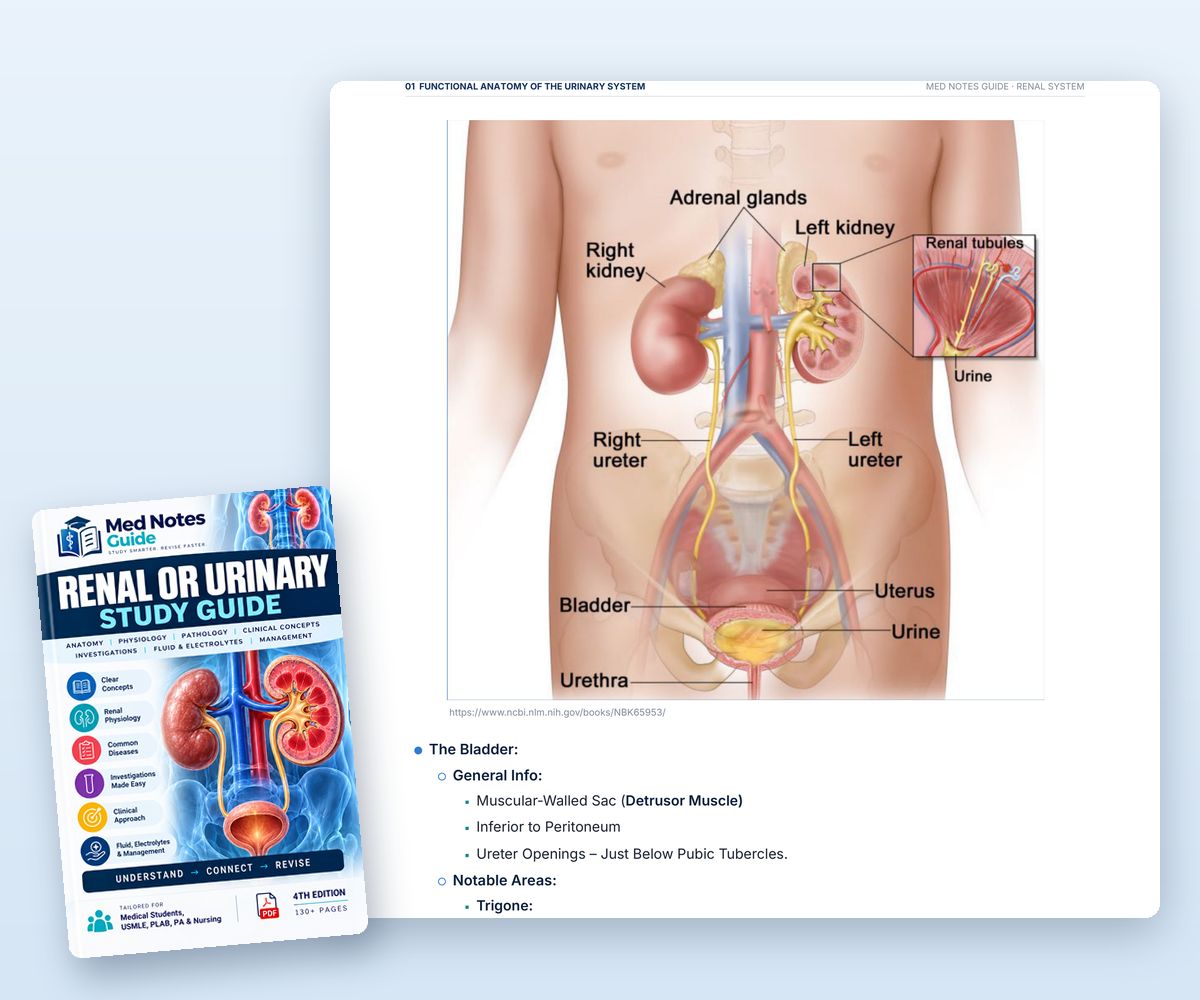
That's the whole idea behind how our guides are organised: each one covers a single system from basic science to clinical, so a system-wise revision session lives in one PDF instead of four textbooks. If you only want one system, single guides such as the Renal System guide are ₹299 each.
All 21 MBBS study guides in one organised library
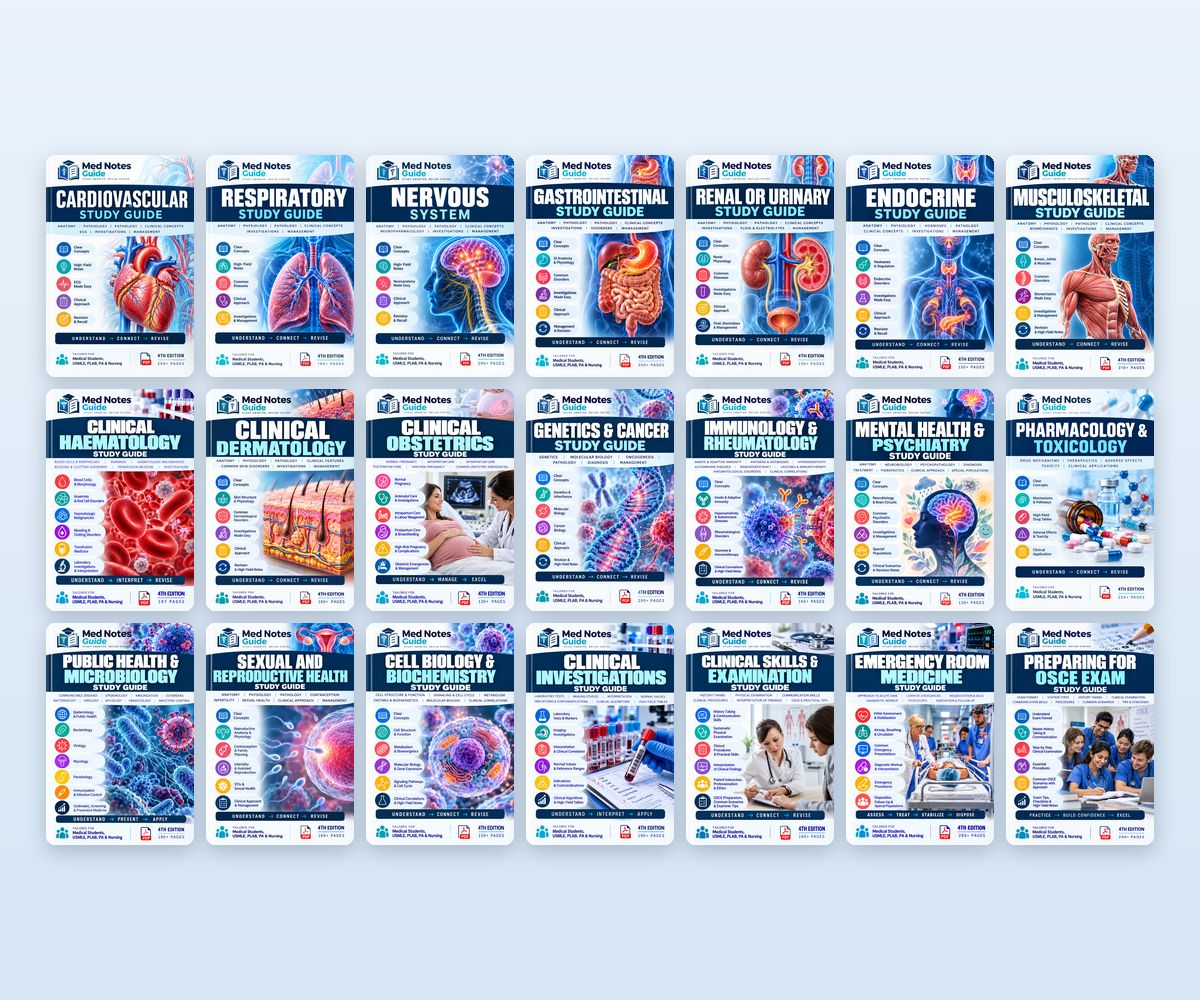
- 21 doctor-written guides, organised system-wise, from Cardiovascular and Renal to Pharmacology, Microbiology and OSCE prep
- 479 chapters · 4,200+ pages of tables, flowcharts and labelled diagrams
- One consistent format: your "one source per subject", ready to revise from
- PDF on your phone, tablet or laptop, emailed instantly after payment
Diwali Sale price ₹1,499 for all 21 ₹6,279 if bought separately
Created by doctors · Trusted by 1,100+ medical students across India · 4.83/5
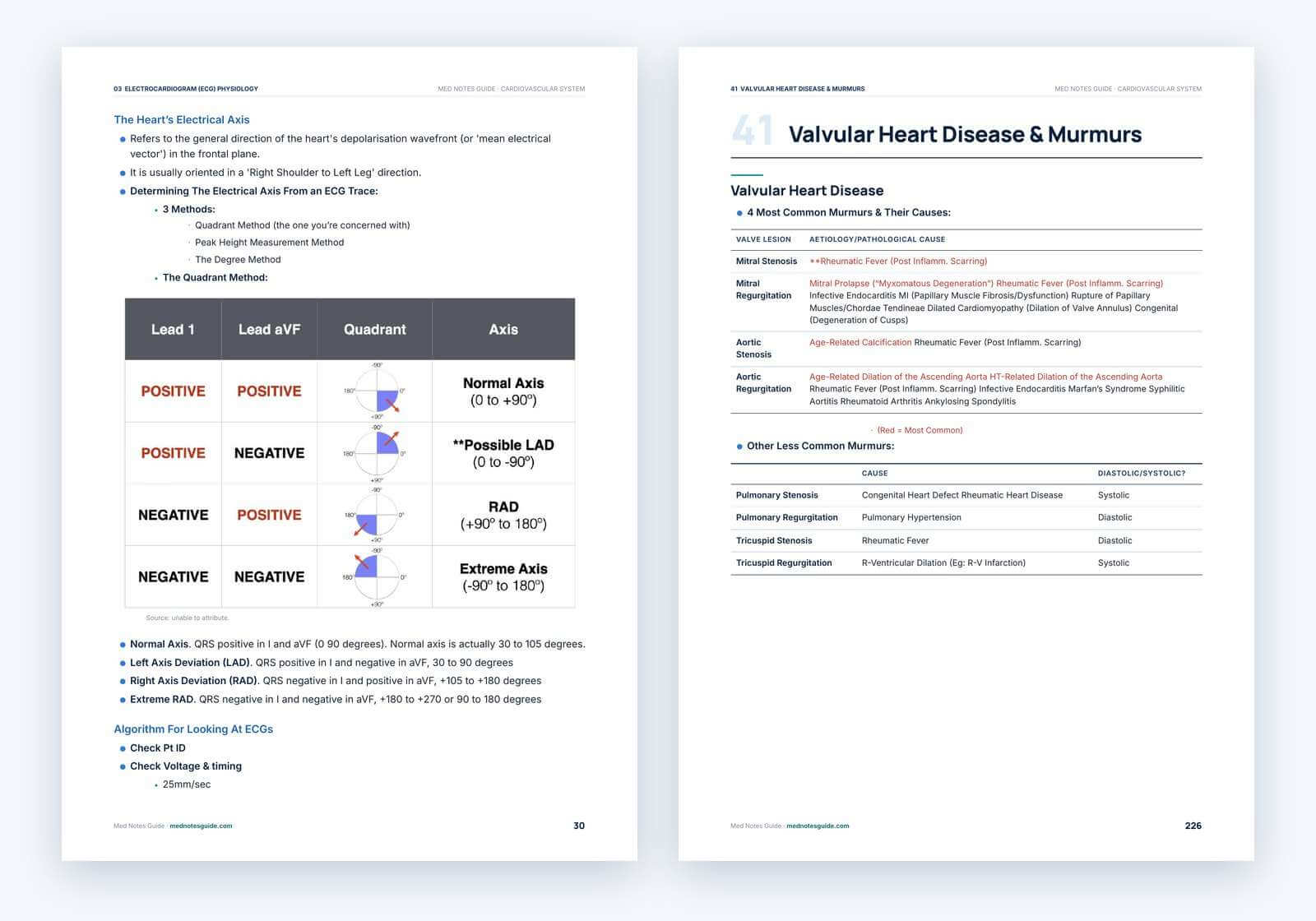
Compress everything into tables and diagrams
In the final weeks you can't re-read chapters. You can scan a page. Turn long text into:
- Comparison tables for anything that comes in pairs or groups: nephrotic vs nephritic, Crohn's vs UC, type 1 vs type 2 hypersensitivity, drug classes vs side effects.
- Flowcharts for mechanisms and pathways: RAAS, coagulation cascade, the stepwise management of asthma.
- Labelled diagrams you redraw from memory: brachial plexus, circle of Willis, cardiac cycle, nephron.
Each table or diagram doubles as a self-test: cover a column, redraw a blank diagram, check.
Your last-30-days plan before a prof exam
| When | Focus | What to do |
|---|---|---|
| Days 30–21 | Full first pass | System by system through your one source. Mark every table and diagram you can't reproduce. |
| Days 20–11 | Weak spots + questions | Revise marked topics only. Daily mixed MCQs and 2–3 SAQs. Practise long-answer structure: definition, classification, features, investigations, management. |
| Days 10–4 | Exam simulation | Timed papers in exam conditions. Viva and OSCE practice with a friend, out loud. Redraw key diagrams. |
| Days 3–1 | Light review | Tables, diagrams and your list of past mistakes only. No new topics. Sleep properly. |
Quick checklist: is your revision working?
- I have one primary source for each subject, and I add new information to it
- I close my notes and test myself at least once per study session
- Each topic has its day-1, day-3, day-7 and day-21 review on a calendar
- I revise one system at a time across anatomy, physiology, pathology and pharmacology
- My key topics live in tables and diagrams I can redraw from memory
- I do MCQs, SAQs and at least one clinical case every week
- I practise OSCE routines and viva answers out loud
- I keep a "mistakes list" and revise it in the final week
The bottom line
You don't need more hours or more material. You need one organised place to revise from, and a habit of pulling information out of memory on a schedule rather than reading it again.
Whether you build that library yourself or start with ours, these four steps will make your next prof exam season calmer. If you'd rather start with a ready-made library, every MBBS system is covered in one place:
Take a look inside the Ultimate Bundle first →
P.S. The guides are a revision resource, not a replacement for your textbooks, lectures, university syllabus or clinical postings. Use them alongside your course.
- Dunlosky J, Rawson KA, Marsh EJ, Nathan MJ, Willingham DT. Improving students' learning with effective learning techniques: promising directions from cognitive and educational psychology. Psychological Science in the Public Interest. 2013;14(1):4–58. doi:10.1177/1529100612453266
- Roediger HL, Karpicke JD. Test-enhanced learning: taking memory tests improves long-term retention. Psychological Science. 2006;17(3):249–255. doi:10.1111/j.1467-9280.2006.01693.x
- Larsen DP, Butler AC, Roediger HL. Test-enhanced learning in medical education. Medical Education. 2008;42(10):959–966. doi:10.1111/j.1365-2923.2008.03124.x
- Cepeda NJ, Pashler H, Vul E, Wixted JT, Rohrer D. Distributed practice in verbal recall tasks: a review and quantitative synthesis. Psychological Bulletin. 2006;132(3):354–380. doi:10.1037/0033-2909.132.3.354