It's 3 a.m. A nurse hands you a blood gas printout and asks, "Is this okay?" Seven numbers stare back at you. If your mind goes blank, you're not alone — most students learn acid–base as a pile of formulas, not a method.
This guide gives you the method. Six questions, always in the same order, that turn any ABG into a clear answer. Then we'll run three real-style cases together so the steps stick.
Grab the free one-page ABG cheat sheet below — print it, screenshot it, keep it on your phone for ward rounds.
Normal ABG values (know these cold)
| Value | Normal range |
|---|---|
| pH | 7.35–7.45 |
| PaCO₂ | 35–45 mmHg (4.7–6.0 kPa) |
| HCO₃⁻ | 22–26 mmol/L |
| PaO₂ (room air) | 80–100 mmHg (10.7–13.3 kPa) |
| Anion gap (Na⁺ − [Cl⁻ + HCO₃⁻]) | about 8–12 mmol/L (lab-dependent) |
Remember the anchors: pH 7.40, PaCO₂ 40, HCO₃⁻ 24. Every step compares the patient with these.
The 6 steps of ABG interpretation
Step 1: Look at the pH — acidaemia or alkalaemia?
- pH < 7.35 → acidaemia
- pH > 7.45 → alkalaemia
- Normal pH doesn't mean normal gas. A normal pH with abnormal CO₂ and HCO₃⁻ can hide a mixed disorder.
Step 2: Find the primary disorder — respiratory or metabolic?
Ask which value explains the pH.
- Acidaemia + high PaCO₂ → respiratory acidosis. Acidaemia + low HCO₃⁻ → metabolic acidosis.
- Alkalaemia + low PaCO₂ → respiratory alkalosis. Alkalaemia + high HCO₃⁻ → metabolic alkalosis.
A quick memory aid: in metabolic disorders, pH and HCO₃⁻ move in the same direction; in respiratory disorders, pH and PaCO₂ move in opposite directions.
Step 3: Check compensation — is it what you'd expect?
The body tries to pull the pH back toward normal. Compare the actual value with the expected one:
| Primary disorder | Expected compensation |
|---|---|
| Metabolic acidosis | PaCO₂ = 1.5 × HCO₃⁻ + 8 (± 2) — Winter's formula |
| Metabolic alkalosis | PaCO₂ = 0.7 × HCO₃⁻ + 20 (± 2) |
| Acute respiratory acidosis | HCO₃⁻ rises ~1 per 10 mmHg rise in PaCO₂ |
| Chronic respiratory acidosis | HCO₃⁻ rises ~3.5–4 per 10 mmHg rise in PaCO₂ |
| Acute respiratory alkalosis | HCO₃⁻ falls ~2 per 10 mmHg fall in PaCO₂ |
| Chronic respiratory alkalosis | HCO₃⁻ falls ~4–5 per 10 mmHg fall in PaCO₂ |
If the measured value is outside the expected range, there's a second disorder. Compensation never overshoots to flip the pH.
Step 4: In metabolic acidosis, use Winter's formula
Winter's formula tells you whether the lungs are blowing off enough CO₂.
- Actual PaCO₂ higher than expected → an additional respiratory acidosis (tiring patient, sedation).
- Actual PaCO₂ lower than expected → an additional respiratory alkalosis (sepsis, salicylates).
Step 5: Calculate the anion gap
Anion gap = Na⁺ − (Cl⁻ + HCO₃⁻), normal about 8–12 mmol/L. Low albumin lowers the gap: add roughly 2.5 for every 10 g/L (1 g/dL) that albumin is below normal.
- High anion gap metabolic acidosis (HAGMA): ketoacidosis, lactic acidosis, renal failure, toxins (methanol, ethylene glycol, salicylates).
- Normal anion gap (hyperchloraemic): diarrhoea, renal tubular acidosis, large volumes of normal saline.
Step 6: If the gap is high, check the delta ratio
Delta ratio = (AG − 12) ÷ (24 − HCO₃⁻)
- < 1 → a normal-gap acidosis is also present
- 1–2 → pure high anion gap acidosis
- > 2 → a metabolic alkalosis is also present (e.g. a vomiting patient in DKA)
Then always link the gas back to the patient. The numbers name the disorder; the history names the cause.
Want this as a full method, not just a blog post?
The Complete Edition includes the full ABG Interpretation Handbook plus 21 doctor-written guides, 15 practice exams and a 12-week study plan.
See the Complete Edition – $59Worked example 1: Diabetic ketoacidosis (DKA)
A 19-year-old with type 1 diabetes has vomiting, abdominal pain and deep, sighing breaths.
pH 7.18 · PaCO₂ 22 mmHg (2.9 kPa) · HCO₃⁻ 8 · Na⁺ 138 · Cl⁻ 100
- pH 7.18 → acidaemia.
- HCO₃⁻ 8 (low) explains it → metabolic acidosis.
- Winter's: 1.5 × 8 + 8 = 20 (range 18–22). Actual PaCO₂ 22 → appropriate respiratory compensation (that's the Kussmaul breathing).
- Anion gap: 138 − (100 + 8) = 30 → high anion gap.
- Delta ratio: (30 − 12) ÷ (24 − 8) = 18 ÷ 16 ≈ 1.1 → pure HAGMA.
Answer: High anion gap metabolic acidosis with appropriate respiratory compensation, consistent with DKA.
Worked example 2: COPD — chronic respiratory acidosis with compensation
A 68-year-old with long-standing COPD attends a routine clinic review. Stable, no new symptoms.
pH 7.34 · PaCO₂ 60 mmHg (8.0 kPa) · HCO₃⁻ 31
- pH 7.34 → mild acidaemia.
- PaCO₂ 60 (high) explains it → respiratory acidosis.
- Acute or chronic? PaCO₂ is up by 20.
- If acute: HCO₃⁻ would rise ~2 → about 26.
- If chronic: HCO₃⁻ would rise ~7–8 → about 31–32.
Answer: Chronic compensated respiratory acidosis (CO₂ retention in COPD).
Watch out: if this patient comes in breathless with a pH of 7.25 and PaCO₂ of 75, that's acute-on-chronic respiratory acidosis — the kidneys haven't caught up, and this patient may need ventilatory support.
Worked example 3: Persistent vomiting — metabolic alkalosis
A 30-year-old has vomited repeatedly for four days and feels weak and dizzy.
pH 7.50 · PaCO₂ 47 mmHg (6.3 kPa) · HCO₃⁻ 36 · K⁺ 3.0
- pH 7.50 → alkalaemia.
- HCO₃⁻ 36 (high) explains it → metabolic alkalosis.
- Expected PaCO₂: 0.7 × 36 + 20 ≈ 45 (range 43–47). Actual 47 → appropriate respiratory compensation (hypoventilation).
Why it happens: losing gastric HCl removes acid, and volume depletion makes the kidneys hold on to bicarbonate. Hypokalaemia is common. A low urine chloride (< 20 mmol/L) points to a saline-responsive cause like this one, so treatment is IV fluid with potassium replacement.
Answer: Metabolic alkalosis with appropriate respiratory compensation, saline-responsive (vomiting).
Practise until it's automatic
Reading ABGs gets easy with repetition. The Complete Edition's 15 practice exams and ABG handbook give you the reps.
Get the Complete EditionABG interpretation summary table
| Disorder | pH | Primary change | Compensation | Common causes |
|---|---|---|---|---|
| Metabolic acidosis | ↓ | HCO₃⁻ ↓ | PaCO₂ ↓ (Winter's) | DKA, lactic acidosis, renal failure, diarrhoea |
| Metabolic alkalosis | ↑ | HCO₃⁻ ↑ | PaCO₂ ↑ | Vomiting, diuretics, NG suction |
| Respiratory acidosis | ↓ | PaCO₂ ↑ | HCO₃⁻ ↑ (more if chronic) | COPD, opioids, neuromuscular weakness |
| Respiratory alkalosis | ↑ | PaCO₂ ↓ | HCO₃⁻ ↓ | Anxiety, pain, PE, early sepsis, altitude |
Your free ABG one-page cheat sheet
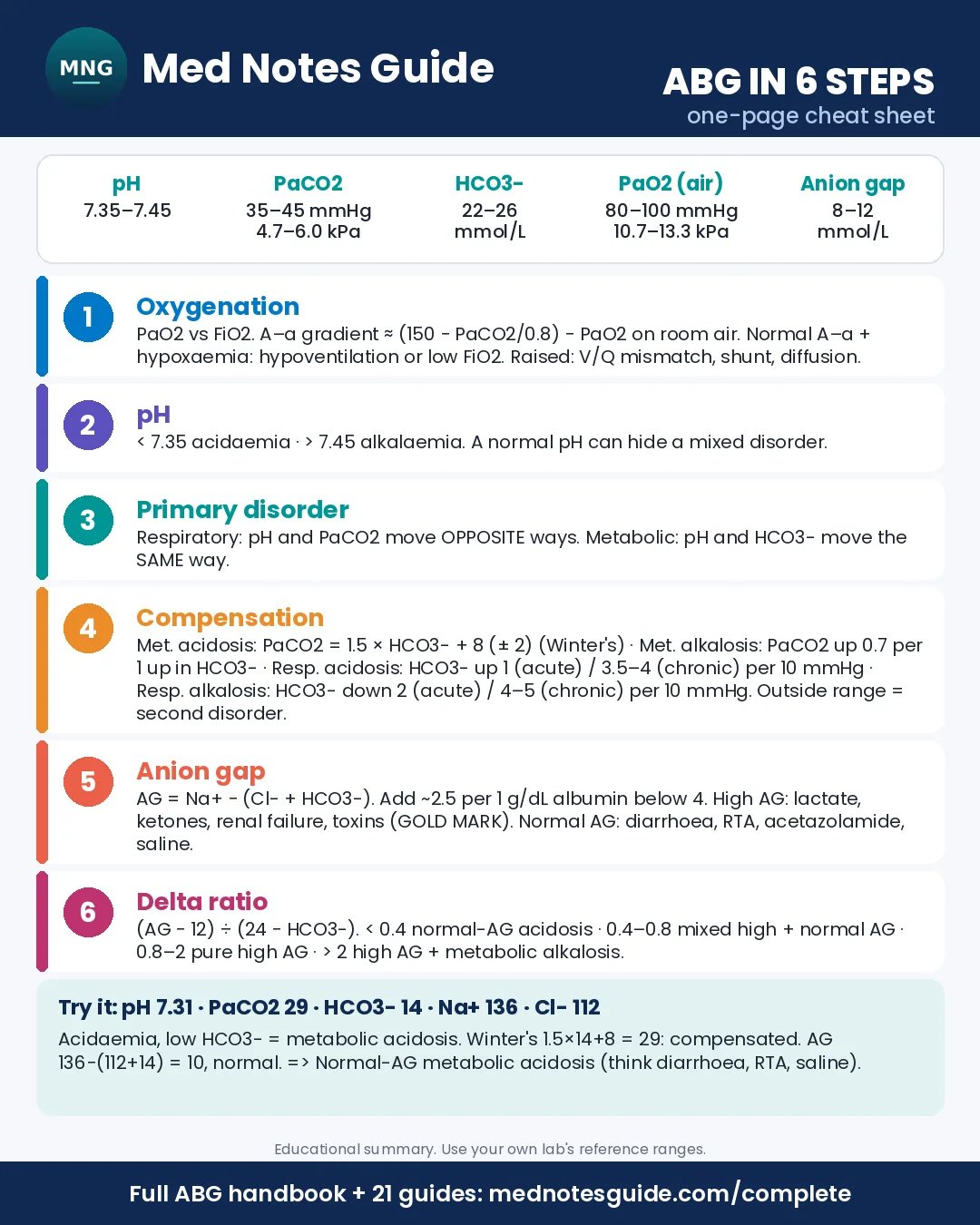
Download the cheat sheet (print-ready image)
All six steps, normal values and formulas on one page. Save it for your next ward round or revision session.
Frequently asked questions
What are the steps to interpret an ABG?
Check the pH, identify whether the primary disorder is respiratory or metabolic, check whether compensation is appropriate, use Winter's formula in metabolic acidosis, calculate the anion gap, and check the delta ratio if the gap is high. Then link the result to the patient's history.
What is Winter's formula?
Winter's formula predicts the expected PaCO₂ in metabolic acidosis: PaCO₂ = 1.5 × HCO₃⁻ + 8 (± 2). If the actual PaCO₂ is higher, there's also a respiratory acidosis; if it's lower, there's also a respiratory alkalosis.
How do you calculate the anion gap?
Anion gap = Na⁺ − (Cl⁻ + HCO₃⁻). A normal value is about 8–12 mmol/L, depending on the lab. Correct for low albumin by adding about 2.5 for every 10 g/L that albumin is below normal.
How can you tell acute from chronic respiratory acidosis?
Look at the bicarbonate. In acute respiratory acidosis HCO₃⁻ rises about 1 mmol/L per 10 mmHg rise in PaCO₂; in chronic respiratory acidosis it rises about 3.5–4 mmol/L, because the kidneys have had days to compensate.
Can an ABG have a normal pH and still be abnormal?
Yes. A normal pH with an abnormal PaCO₂ and HCO₃⁻ can mean two opposing disorders are present at once, such as a metabolic acidosis with a respiratory alkalosis. Always check every value, not just the pH.
Keep going
Next, sharpen your pharmacology: Beta-Blocker Side Effects: The High-Yield Cheat Sheet.
- How to Read an EKG: A Step-by-Step System (With Examples)
- Hyperkalaemia: EKG Changes, Causes and Emergency Management
Master acid–base and everything else, in one place
Med Notes Guide Complete Edition: 21 doctor-written guides, 15 practice exams, the ABG handbook and a 12-week study plan. $59.
Get the Complete EditionEducational content for students only. Not medical advice. Reference ranges vary between labs, so always check your local guidelines and lab values.