Pharmacology for nursing students
Top 200 Drugs, Visualized

Stop memorizing 200 drugs. Learn 44 classes, then only what's different.

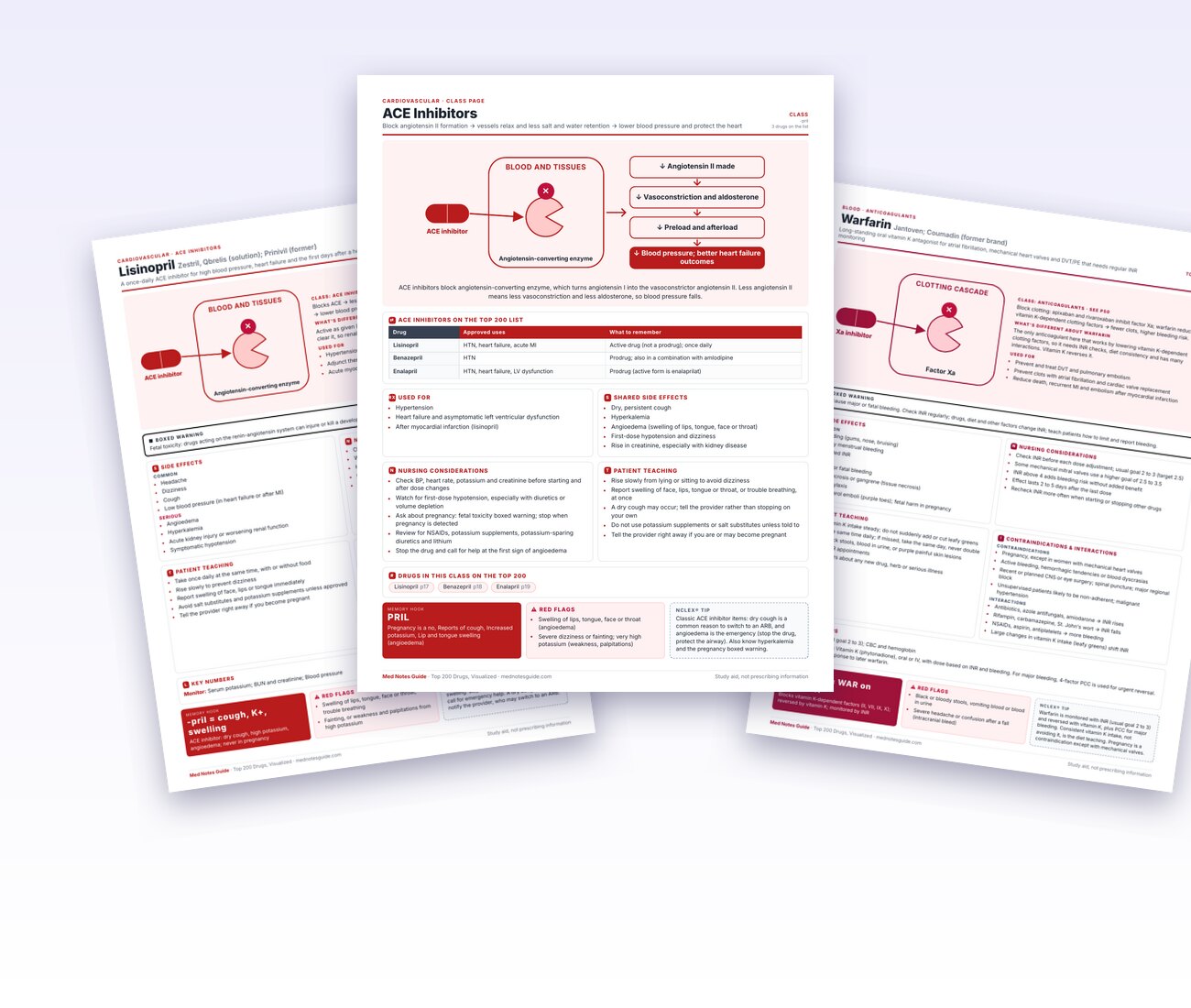
Top 200 Drugs class and drug pages fanned out
244 one-page sheets. 44 class pages and 200 drug pages, color-coded by body system.
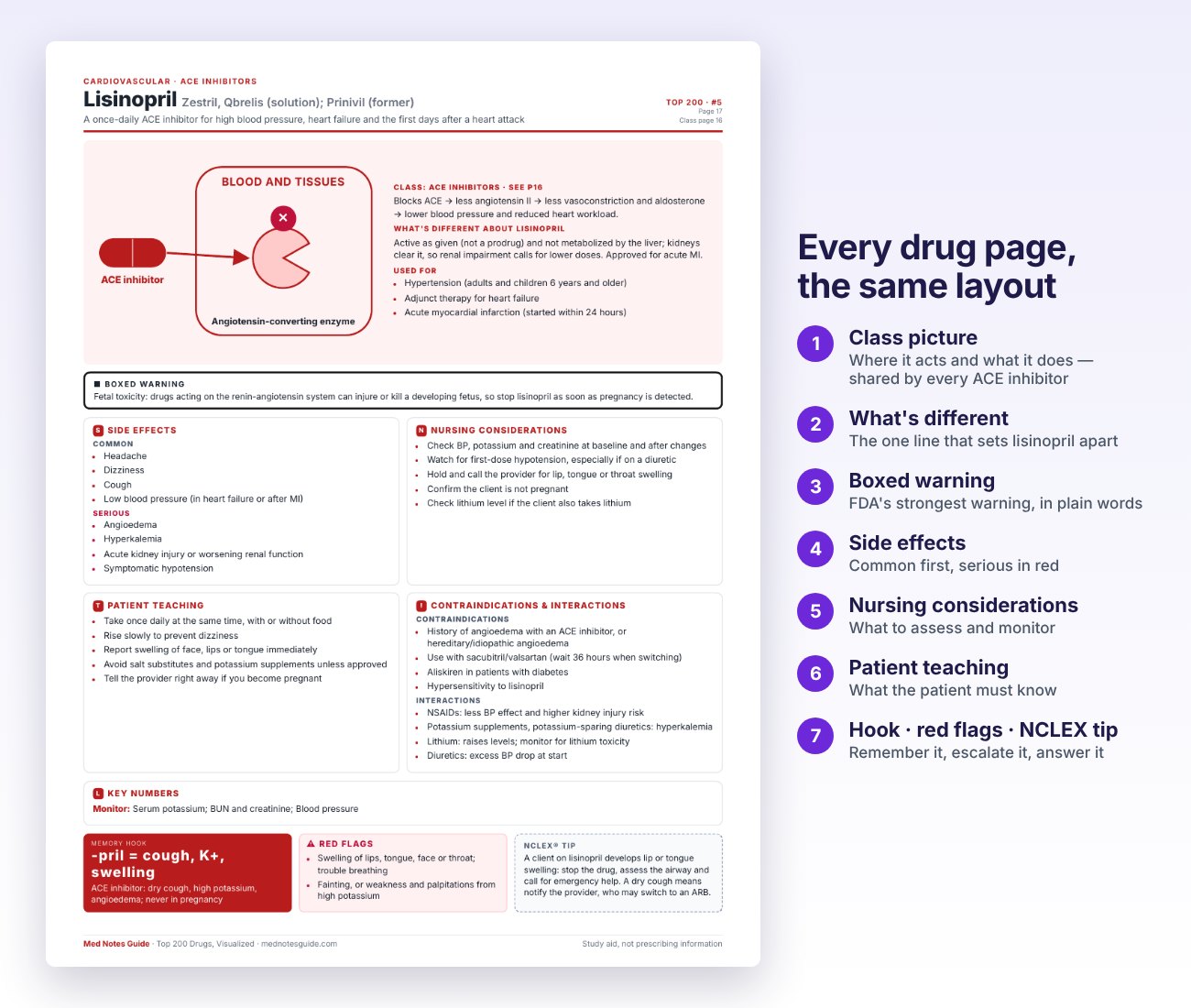
A drug page with its sections labelled
Every drug, same layout: class picture, what's different, boxed warning, side effects, nursing care, teaching, red flags, NCLEX tip.
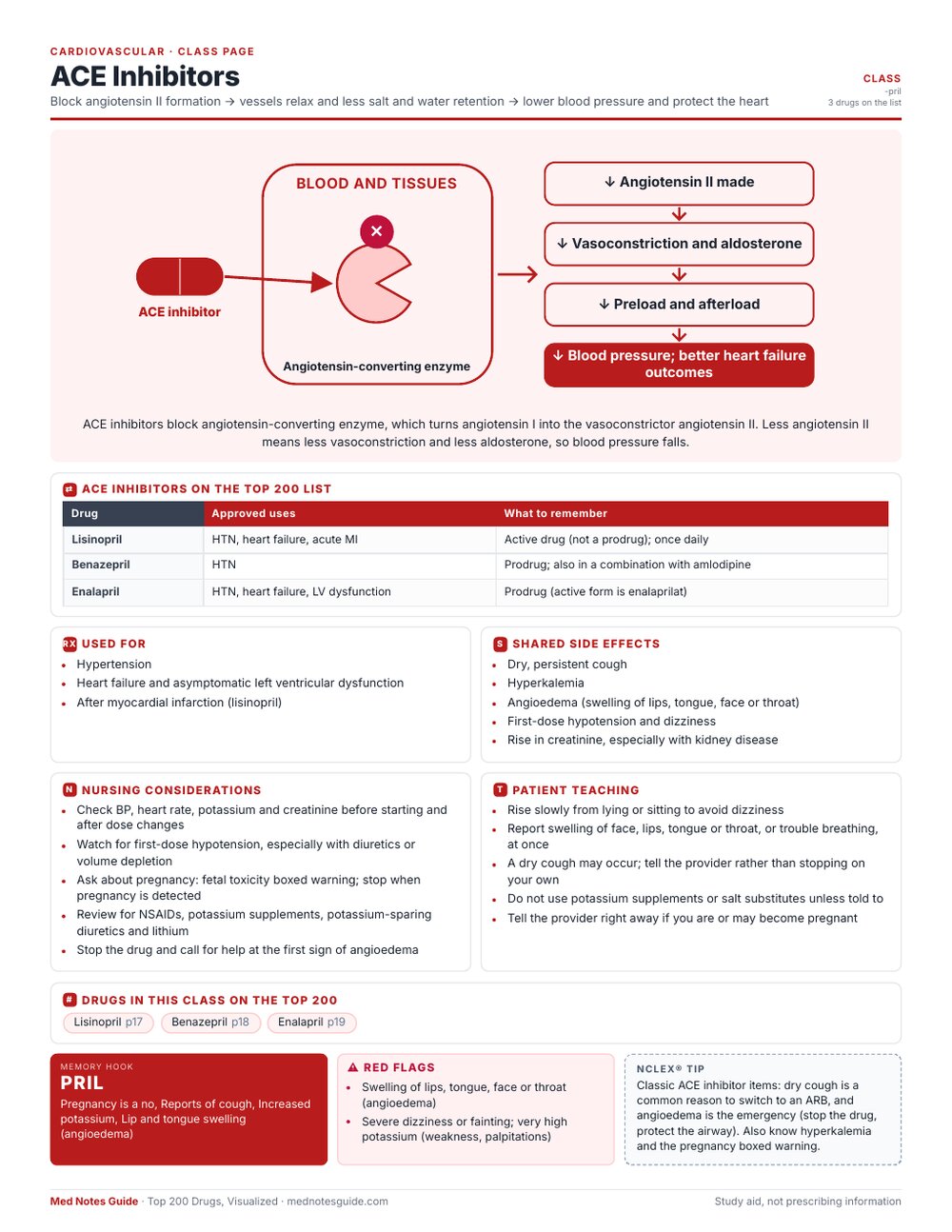
Class page: ACE inhibitors page
Class page: ACE inhibitors: the mechanism once, every ACE inhibitor side by side.
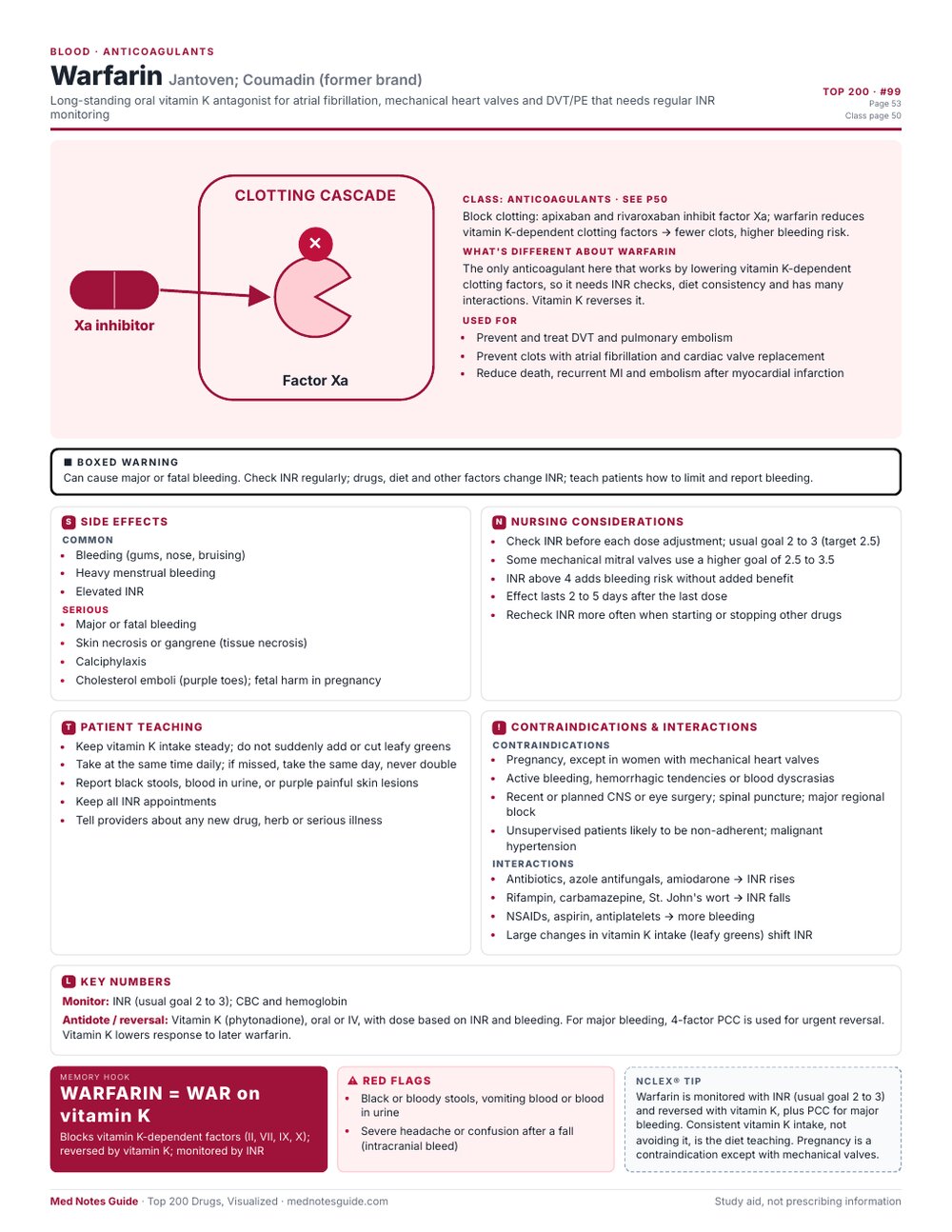
Warfarin page
Warfarin: INR, vitamin K, PCC and the food teaching.
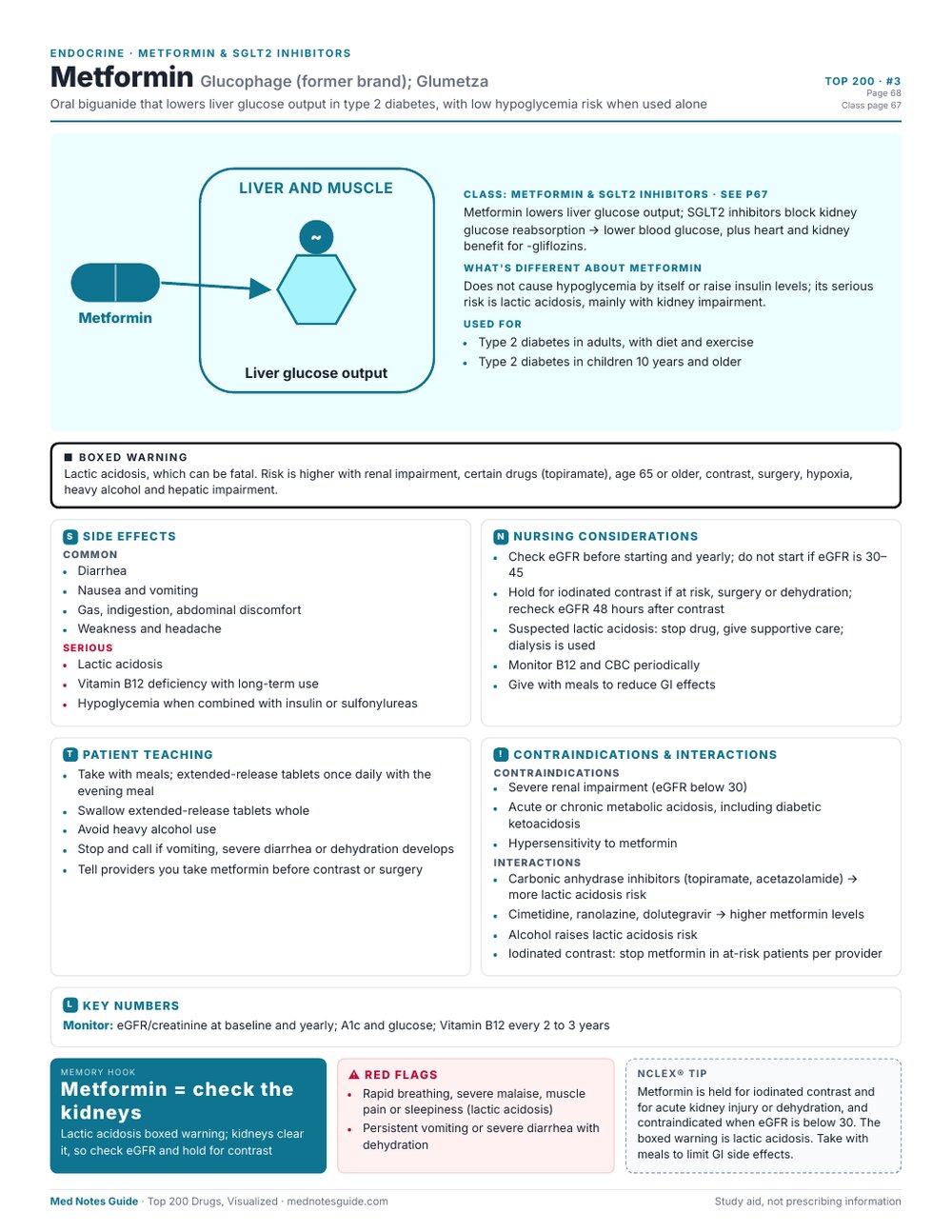
Metformin page
Metformin: lactic acidosis box and the eGFR rules.
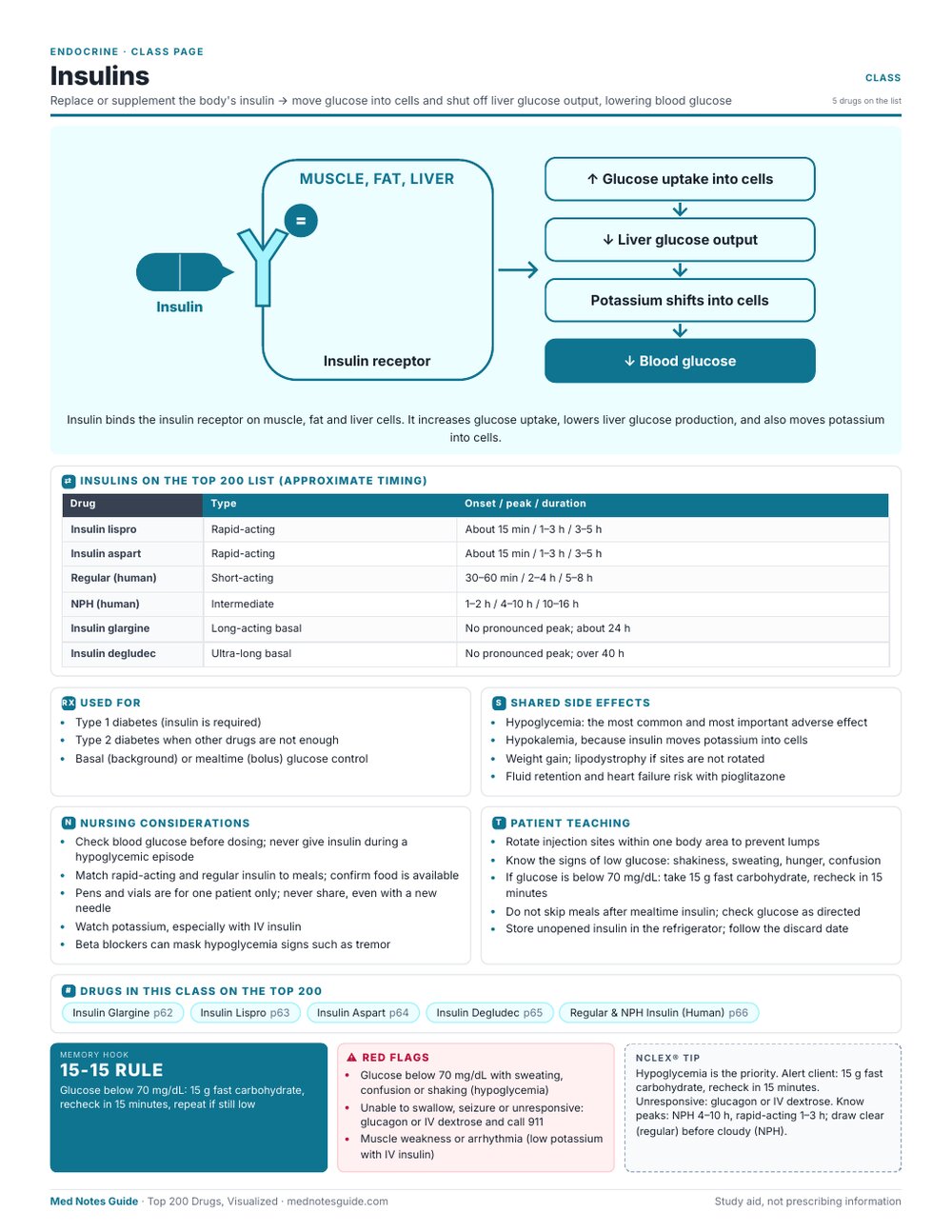
Class page: insulins page
Class page: insulins: onset, peak and duration in one table.
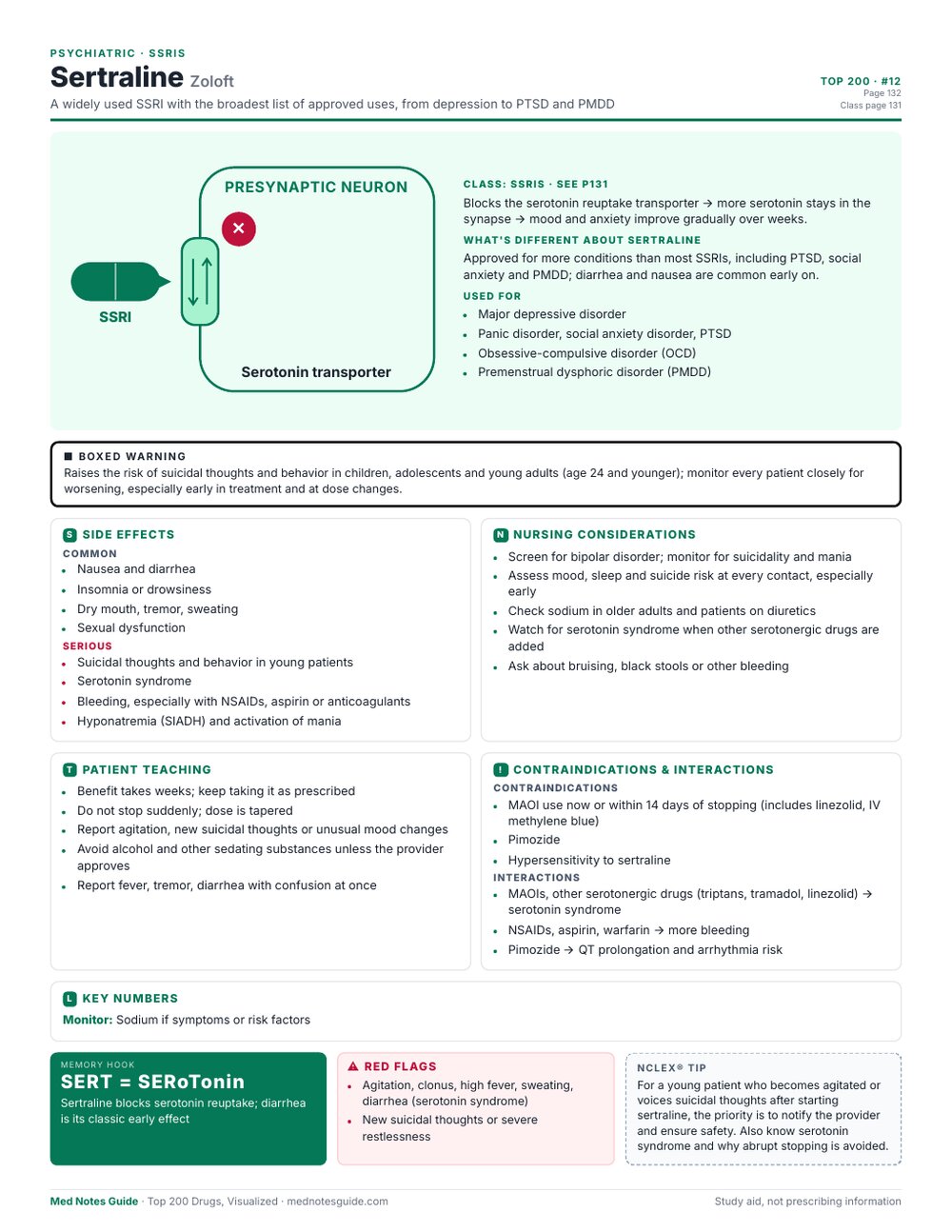
Sertraline page
Sertraline: suicidality box and serotonin syndrome.
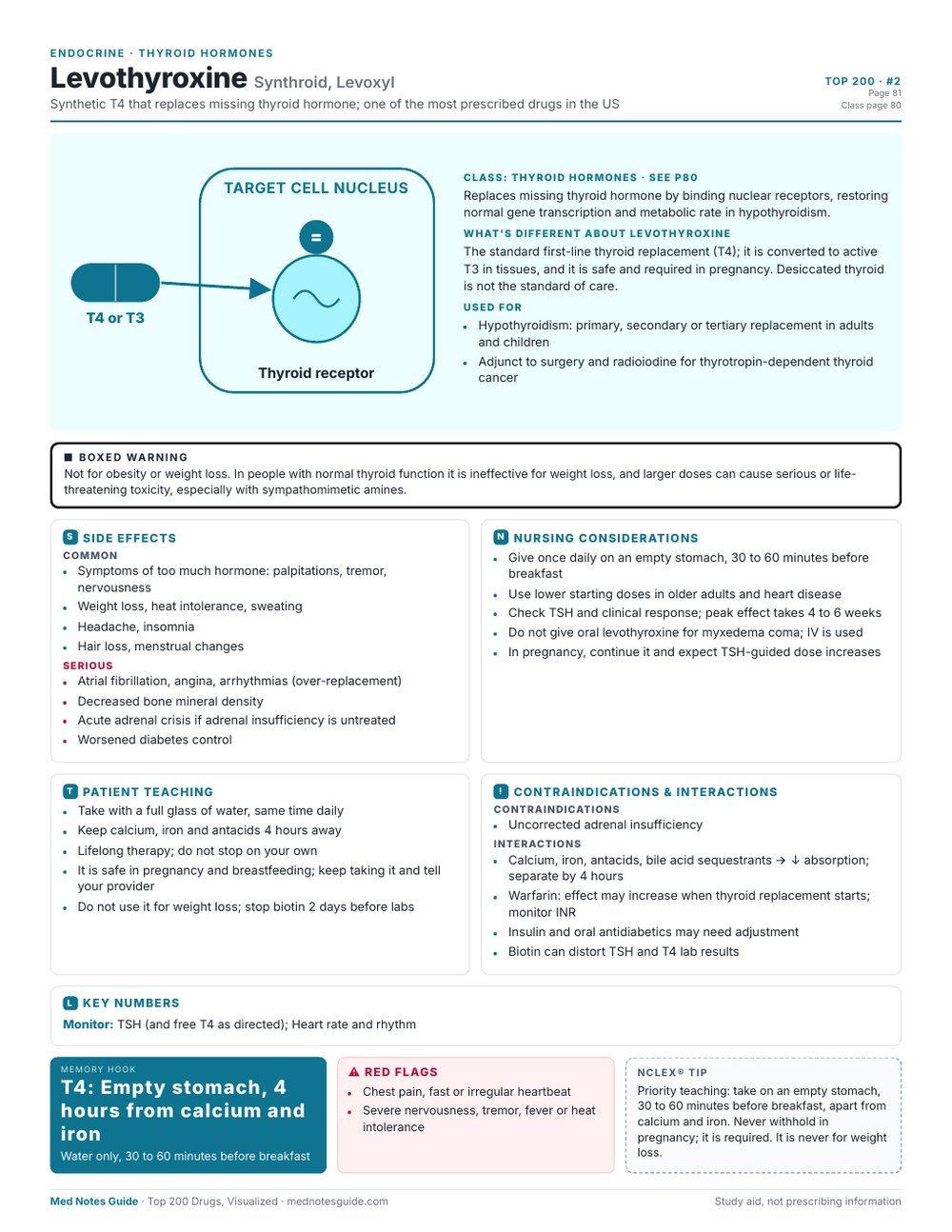
Levothyroxine page
Levothyroxine: empty stomach, 4-hour gap, pregnancy.
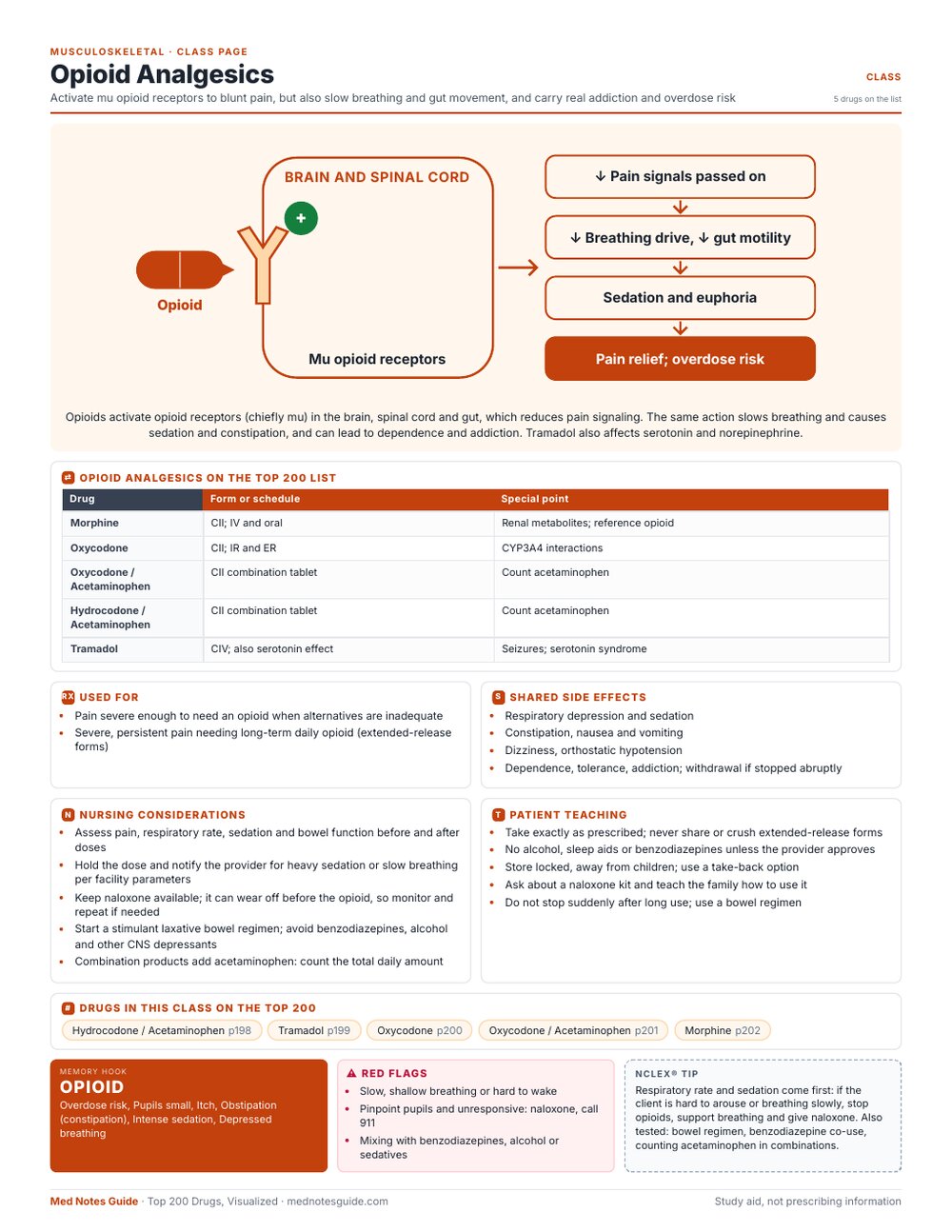
Class page: opioids page
Class page: opioids: respiratory depression, naloxone, the full box.
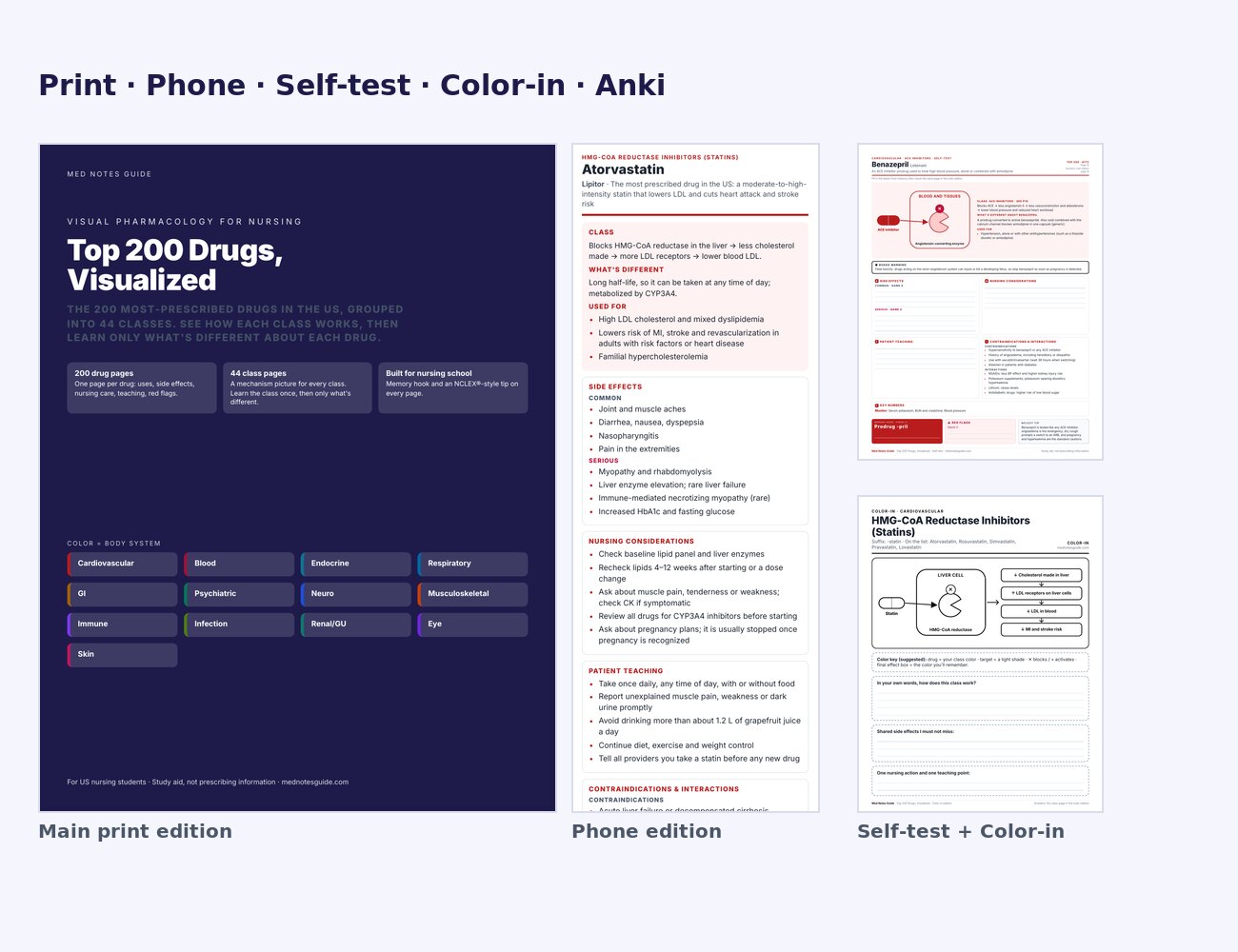
Main, phone, self-test and color-in editions
Print, phone, self-test and color-in editions plus an Anki deck.
Swipe to see real pages →

One page for each of the 200 most-prescribed drugs in the US, grouped into 44 classes. Each class gets a mechanism picture, so you understand the class once and only learn what sets each drug apart.

Get Top 200 Drugs · $27
One-time payment · PDFs emailed in minutes · 7-day money-back guarantee
200drug pages
44class mechanism pictures
1,472flashcards included
$27once, no subscription
The problem

Pharm isn't hard. It's just 200 lists that all look the same.

Every drug comes with a class, a mechanism, eight side effects, five nursing considerations and something to teach. Multiply that by two hundred and you get the subject nursing students dread most: pages of flashcards that blur together the night before the exam.

Then the exam doesn't ask you to recite a list. It asks something like this:

A client started on lisinopril reports a dry, nagging cough. What does the nurse do?

You don't answer that by memorizing lisinopril. You answer it by knowing what every ACE inhibitor does, and which side effects come with the whole class.

Learn the class once. Then each drug is one line: what's different.

A class page with its mechanism picture
How it works

44 class pages. One picture each.

Every class opens with a simple diagram: where the drug acts, what it blocks or switches on, and what happens next, ending in the clinical effect. Under it: a side-by-side table of the class's drugs, the side effects they all share, the drug-name suffix, and a memory hook.

Then come the drug pages, each with the class picture as a thumbnail and one line on what makes that drug different.

Mechanism pictureDrug → target → effect, drawn the same way for every class.
What's differentThe one fact that separates this drug from its classmates.
■ Boxed warningThe FDA's strongest warning in plain words, whenever the drug has one.
Nursing considerationsWhat to assess and monitor before and after you give it.
Patient teachingWhat the patient must know to take it safely.
⚠ Red flagsThe findings you escalate now. Always in red.

Plus a memory hook, the key labs and antidote, and an NCLEX®-style tip on every page.

What you get

200 drugs, color-coded by body system.

Chosen from ClinCalc's ranking of the most-prescribed drugs in the US, built on federal survey data. Every page was written from the drug's current FDA label and then checked against it independently.

Cardiovascular · 36 drugsHMG-CoA Reductase Inhibitors, Other Lipid-Lowering Drugs, ACE Inhibitors, Angiotensin II Receptor Blockers, Beta-Adrenergic Blockers, Calcium Channel Blockers, Diuretics, Other Antihypertensives, Nitrates & Antiarrhythmics
Blood · 8 drugsAnticoagulants, Antiplatelets, Vitamins, Iron & Minerals
Endocrine · 33 drugsInsulins, Metformin & SGLT2 Inhibitors, GLP-1, Sulfonylureas, DPP-4 Inhibitors & Thiazolidinediones, Thyroid Hormones, Corticosteroids, Sex Hormones, Contraceptives & Hormone Blockers, Bone & Electrolyte Supplements
Respiratory · 15 drugsBronchodilators, Inhaled Corticosteroid Combinations, Antihistamines, Leukotriene Blockers & Cough Drugs
GI · 9 drugsAcid Reducers, Antiemetics, Motility & Bowel Drugs
Psychiatric · 32 drugsSSRIs, SNRIs, Atypical Antidepressants & TCAs, Benzodiazepines, Hypnotics & Anxiolytics, Antipsychotics & Lithium, ADHD Drugs & CNS Stimulants
Neuro · 12 drugsAntiepileptics, Gabapentinoids, Dementia, Parkinson's & Migraine Drugs
Musculoskeletal · 18 drugsSkeletal Muscle Relaxants, Non-Opioid Analgesics, Opioid Analgesics, Gout & Uric Acid Drugs
Immune · 7 drugsImmunosuppressants, DMARDs & Biologics
Infection · 18 drugsBeta-Lactam Antibiotics, Other Antibiotics, Antivirals & Antifungals
Renal/GU · 7 drugsUrinary & Prostate Drugs
Eye · 3 drugsGlaucoma Eye Drops
Skin · 2 drugsTopical Skin Drugs
Also included, at no extra cost

Five more ways to learn the same 200 drugs

📱 Phone editionEvery page in one column, sized for your phone. Read it between classes or on clinical.
✎ Self-test editionThe drug pages with side effects, nursing care, teaching and red flags blanked out. Recall, then check.
🎨 Color-in editionAll 44 mechanism diagrams as line art, with space to explain each one in your own words.
🃏 1,472 flashcardsClass, suffix, side-effect, boxed-warning, antidote and brand-name cards, as a PDF and a ready-made Anki deck.
🔍 A–Z drug finderGeneric names, brand names, classes and suffixes, each with its page number.
How students use it

One or two classes a day.

  1. Read the class page first (5 minutes). Look at the picture until you could redraw it. That's the mechanism for every drug in the class.
  2. Then skim the drug pages. Read "what's different", the boxed warning and the red flags. Most of the rest you already know from the class.
  3. Next day, use the self-test edition. Fill in the blanks from memory, then check the same page in the main edition.
  4. Before an exam: read only the class pages and each drug's "what's different" line. The whole book in an evening.

Print the classes you're studying, annotate them on an iPad, or keep the phone edition open. They're yours to keep.

This is for you if…

  • You're in an ADN, BSN, accelerated or LPN program and pharm is coming up
  • You understand things better from a diagram than from a paragraph
  • You want the most-prescribed drugs, not every drug ever made
  • You'd rather pay once than keep paying a monthly subscription

It's not for you if…

  • You want a question bank. This is a visual study guide, not practice questions
  • You need a drug reference for practice. It's a study aid, not prescribing information
  • You need drugs outside the top 200, such as most IV-only critical-care drugs
Get instant access

One payment. All 200 drugs. Yours to keep.

Top 200 Drugs, Visualized
$27
one-time · no subscription
  • 200 one-page drug pages, ranked by US prescriptions
  • 44 class pages with a mechanism picture for each
  • Boxed warning, side effects, nursing care, teaching, red flags and NCLEX tip on every drug
  • Phone edition
  • Self-test edition
  • Color-in edition of all 44 mechanism diagrams
  • 1,472 flashcards (printable PDF + Anki deck)
  • A–Z drug finder with page numbers
  • Emailed to you within minutes
Get Top 200 Drugs · $27
7-DAY
MONEY
BACK
Try it for 7 days. If it isn't what you expected, email us within 7 days and we'll refund you. No forms, no fuss.
Questions

Before you buy

What exactly do I receive?

One email with everything: the main print edition (US Letter, 250 pages, as one file and as two smaller parts), the phone edition, the self-test edition, the color-in edition, and the flashcards (PDF, Anki deck and CSV) with the A–Z drug finder.

How were the 200 drugs chosen?

From ClinCalc's DrugStats ranking of the most-prescribed drugs in the US, which is built on the federal Medical Expenditure Panel Survey. Combination products whose parts already have their own page are covered on those pages.

Where do the facts come from?

Each page was written from the drug's current US FDA prescribing information and standard nursing pharmacology, then checked against that label by a separate review: class, mechanism, boxed warning, contraindications, side effects, interactions, monitoring and antidotes.

Does it include doses?

Only where a typical adult dose is a classic exam fact, and it's marked "typical adult". This is a study aid, not prescribing information. In practice, always follow the order and an approved drug reference.

Is it a subscription?

No. You pay $27 once and the files are yours to keep. No account, no login, nothing that expires.

Can I use it on my phone?

Yes. The phone edition lays every page out in one column so it reads without zooming, and every file opens in any PDF reader.

What if I don't like it?

Email support@mednotesguide.com within 7 days of buying and we'll refund you.

Stop memorizing. Start seeing it.

200 drugs, 44 classes, one page each. $27 once.

Get Top 200 Drugs · $27
PDFs emailed in minutes · 7-day money-back guarantee